
Exosome skincare is an emerging approach that uses tiny extracellular vesicles involved in cell-to-cell communication. Early laboratory and human studies suggest that exosome-based treatments may support collagen production, skin hydration, elasticity, wound healing, and overall skin appearance. However, the evidence is still developing, and products and treatments vary widely in their sources, preparation, and delivery methods.
If you’ve been following newer skincare trends, you’ve probably noticed exosomes in skincare appearing in serums, facials, and professional treatments. They’re often discussed alongside regenerative skincare, stem-cell research, and anti-aging treatments.
But what exactly are exosomes? Do exosome serums really work? And are professional exosome facial treatments worth considering?
The science is interesting, but it’s also important to separate promising research from marketing claims.
What Are Exosomes?
Exosomes are extremely small membrane-bound extracellular vesicles released by cells. Think of them as microscopic packages that cells use to communicate with other cells.
These vesicles can contain biologically active materials, including proteins, lipids, and nucleic acids. When they interact with other cells, they may influence cellular signaling and biological processes.

This communication system is one reason researchers became interested in exosomes for regenerative medicine and dermatology.
In skin research, scientists are studying whether exosomes can influence processes involved in:
- Collagen and extracellular matrix production
- Inflammation
- Wound healing
- Cell migration
- Skin barrier function
- Tissue remodeling
- Oxidative stress
- Skin aging
It’s worth remembering that exosomes aren’t the same thing as stem cells. Exosomes are vesicles released by cells; they don’t contain an entire living cell.
What Is Exosome Skincare?
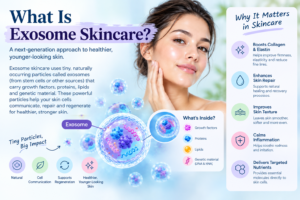
Exosome skincare refers to cosmetic or professional skincare products and procedures that contain or use exosome-related extracellular vesicles.
Depending on the product or treatment, these materials may come from different biological sources. Research and commercial products have included vesicles derived from human cells as well as plant-based sources.
This is important because the word “exosome” doesn’t automatically tell you:
- Where the vesicles came from
- How they were isolated
- How they were processed
- What concentration is present
- How stable the formulation is
- Whether the product contains intact exosomes
- How the ingredients are delivered into the skin
A 2026 scoping review found considerable variation among commercially available topical exosome products and noted that information about isolation, processing, and shelf life was often limited.
So, not every product marketed as an exosome serum should be assumed to have the same biological activity or clinical evidence.
How Does Exosome Skincare Work?
The basic idea is that exosomes can act as biological messengers.
When released from cells, they can interact with other cells and deliver molecular signals. Researchers are investigating whether these signals can influence pathways involved in skin repair and regeneration.
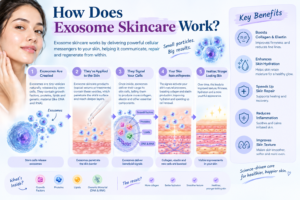
1. Cell-to-Cell Communication
Exosomes can carry signaling molecules between cells.
This may help explain why researchers are investigating them as potential tools for influencing skin-cell behavior.
2. Collagen and Extracellular Matrix Support
Laboratory research suggests that extracellular vesicles may influence pathways involved in collagen, elastin, and other extracellular matrix components.
Since collagen and elastin contribute to skin structure and elasticity, this is one reason exosomes are being studied for skin rejuvenation.
3. Inflammation Modulation
Some research suggests exosome-related signaling may affect inflammatory pathways.
That doesn’t mean exosomes can treat every inflammatory skin condition. Rather, it is one biological mechanism researchers are exploring.
4. Wound Healing
Exosomes have also been studied in relation to tissue repair and wound healing.
Research suggests they may influence processes such as cell migration, blood-vessel formation, and extracellular matrix remodeling.
What Are the Potential Exosome Skincare Benefits?
The potential exosome skincare benefits are still being investigated, but human studies have reported improvements in several skin measurements.
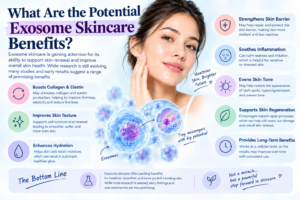
Possible benefits include:
- Improved skin hydration
- Better skin elasticity
- Reduction in the appearance of some wrinkles
- Improved skin texture
- Changes in pigmentation
- Support for skin regeneration
- Potential improvement in certain scars
- Support for wound-healing processes
A 2026 systematic review of human studies found associations between exosome-based interventions and improvements in hydration, elasticity, wrinkles, pores, pigmentation, and overall appearance. However, the researchers also emphasized substantial differences between studies and a lack of long-term evidence.
Another 2026 scoping review of topical exosomes found reported improvements in wrinkles, elasticity, hydration, pigmentation, collagen, and elastin, but concluded that human evidence remains limited.
That distinction matters: promising results aren’t the same as definitive proof.
Exosomes for Anti-Aging: Can They Reduce Wrinkles?
This is one of the most talked-about uses of exosomes for skin.
Skin aging involves multiple processes, including changes in collagen and elastin, cumulative environmental exposure, oxidative stress, and changes in cellular function.
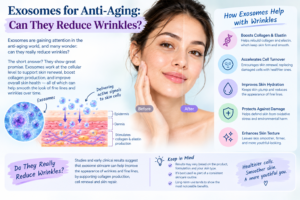
Because exosomes may influence cell signaling and extracellular matrix activity, researchers are investigating whether they can help improve visible signs of skin aging.
Human studies have reported improvements in wrinkle appearance and other measures of skin quality. A 2026 meta-analysis of human clinical studies reported improvements across several aesthetic outcomes, but also noted that differences between studies and treatment protocols limit how broadly the results can be applied.
So it’s more accurate to say:
Exosomes are a promising area of anti-aging research, but they aren’t yet a proven replacement for established skincare and dermatological treatments.
What Is an Exosome Serum?
An exosome serum is a topical skincare product marketed as containing exosomes or extracellular vesicles.
These serums are generally designed to be applied directly to the skin, often as part of a broader skincare routine.
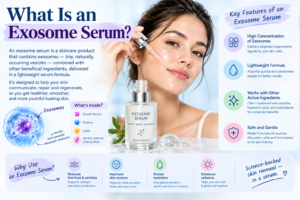
However, topical delivery raises an important question: Can these large biological vesicles actually reach the skin cells in a meaningful way?
The answer depends on the formulation, vesicle characteristics, skin condition, and delivery system.
Some research has examined topical exosomes alone, while other studies have combined them with procedures such as microneedling or laser treatments.
This makes it difficult to assume that the results from a professional procedure apply directly to an ordinary cosmetic serum.
What Is an Exosome Facial Treatment?
An exosome facial treatment is a professional aesthetic procedure that incorporates exosome or extracellular-vesicle preparations into a skin-rejuvenation treatment.
The exact procedure can vary considerably.
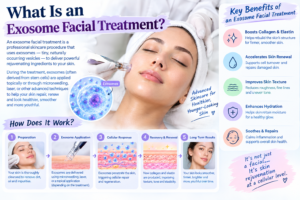
Some clinical studies have investigated topical application after procedures such as:
- Microneedling
- Fractional laser treatment
- Other skin-resurfacing procedures
Other research has examined topical application without an additional procedure.
The delivery method matters because procedures that temporarily alter the skin barrier may change how topical substances interact with the skin.
This is one reason you shouldn’t assume that an exosome facial treatment and an over-the-counter exosome serum provide equivalent results.
Exosome Treatment for Skin: What Does the Research Say?
Research into exosome treatment for skin is growing, but it remains an emerging field.
A 2026 systematic review identified 19 human studies of exosome-based interventions for skin rejuvenation. Many reported short-term improvements in areas such as hydration, elasticity, wrinkles, pigmentation, and overall appearance. However, most studies were not randomized, and the authors highlighted methodological differences and limited follow-up.
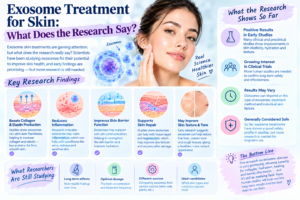
Another 2026 review examining topical exosomes identified 18 studies and found that only a relatively small body of clinical evidence directly evaluates topical exosomes for skin rejuvenation.
There are also broader reviews covering extracellular vesicles and exosome-based approaches in skin aging, scarring, wound healing, and other dermatological applications. These reviews generally describe the technology as promising while emphasizing the need for better-designed clinical trials.
Why is the evidence difficult to interpret?
Studies may differ in:
- Exosome source
- Isolation method
- Purification process
- Concentration
- Storage conditions
- Delivery method
- Treatment frequency
- Combination with other procedures
- Patient characteristics
- Follow-up period
When treatments differ this much, it’s difficult to say that one standard “exosome treatment” has been proven to work.
Exosomes for Skin Rejuvenation: What Can You Realistically Expect?
It’s tempting to look at exosomes as a shortcut to younger-looking skin. The current evidence doesn’t justify that expectation.
Research suggests potential improvements in:
Hydration → Elasticity → Texture → Pigmentation → Wrinkle appearance
But results can vary, and the strongest evidence still doesn’t establish one standardized treatment protocol.
A 2026 review of topical exosomes specifically highlighted the need for stronger clinical evidence and better standardization of both products and delivery methods.
For consumers, this means it’s better to think of exosomes as an emerging technology rather than a guaranteed anti-aging solution.
Are Exosome Skincare Products Safe?
Safety depends heavily on the specific product, source, manufacturing process, and method of use.
Human studies of topical applications have generally reported favorable short-term safety findings, although the evidence base is still limited. Injectable use raises different safety considerations, and adverse events have been reported in some clinical literature.
The FDA has also issued public safety information concerning unapproved exosome products. In the United States, the FDA states that there are currently no FDA-approved exosome products.
That doesn’t mean every product marketed with the word “exosome” is necessarily dangerous. It means consumers should not confuse a product’s marketing claims with regulatory approval or established clinical effectiveness.
Exosome Therapy for Skin vs. Regular Skincare
Exosome therapy shouldn’t automatically replace basic skincare.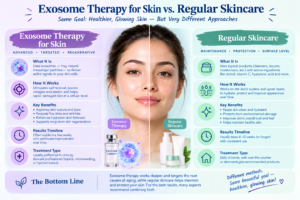
A simple routine can still focus on well-established fundamentals:
Morning
- Gentle cleanser
- Moisturizer
- Broad-spectrum sunscreen
Evening
- Cleanser
- Appropriate treatment product
- Moisturizer
Depending on your skin concerns, ingredients such as retinoids, vitamin C, niacinamide, or other evidence-supported products may have a more established role.
Exosome-based products may be considered an emerging addition rather than the foundation of a skincare routine.
How to Evaluate an Exosome Serum
If you’re considering an exosome serum, don’t judge it only by the word “exosome” on the package.
Look for clear information about:
1. Source
Does the manufacturer explain where the extracellular vesicles come from?
2. Formulation
Does the company clearly describe what the product contains?
3. Evidence
Are there actual human studies supporting the specific product or formulation?
4. Storage
Biological materials can be sensitive to processing and storage conditions. Clear storage instructions are important.
5. Manufacturing Information
Look for transparent information about how the product is manufactured and tested.
6. Claims
Be cautious about dramatic promises such as “permanent anti-aging,” “instant regeneration,” or guaranteed wrinkle removal.
A product claim isn’t the same thing as clinical evidence.
Common Mistakes With Exosome Skincare
Mistake 1: Assuming All Exosomes Are the Same
They’re not.
Different sources and manufacturing processes can produce substantially different products.
Mistake 2: Confusing Exosomes With Stem Cells
Exosomes are extracellular vesicles released by cells. They aren’t living stem cells.
Mistake 3: Believing More Expensive Means More Effective
Price doesn’t establish clinical effectiveness.
Mistake 4: Treating Marketing Claims as Scientific Evidence
Look for human clinical research rather than relying only on before-and-after photographs.
Mistake 5: Using Injectable Products Without Medical Guidance
Injectable applications are different from topical cosmetics and may carry additional risks.
Mistake 6: Ignoring Sun Protection
No emerging regenerative skincare ingredient replaces daily sun protection.
Who Should Consider Exosome Skincare?
There isn’t enough evidence to recommend exosome products as a standard treatment for everyone.
Someone interested in this technology should first consider:
- Their specific skin concern
- The type of product or treatment being offered
- The source of the exosomes or extracellular vesicles
- The available human evidence
- Possible side effects
- The qualifications of the person providing the treatment
- The regulatory status in their country
For professional or injectable treatments, discussing the option with a qualified dermatologist or other appropriately trained healthcare professional is particularly important.
Exosome Skincare: What Does the Future Look Like?
The scientific interest in extracellular vesicles is unlikely to disappear.
Researchers are studying how these tiny biological messengers might be used in:
- Skin rejuvenation
- Wound healing
- Scar management
- Pigmentation
- Hair-related applications
- Tissue regeneration
- Drug delivery
The major challenge isn’t simply proving that exosomes can influence cells in a laboratory. Researchers also need to determine which sources, formulations, doses, delivery methods, and treatment schedules work reliably in people.
Standardization is therefore one of the biggest issues facing the field.
Frequently Asked Questions
1. What is exosome skincare?
Exosome skincare refers to cosmetic products or professional treatments that use exosomes or extracellular vesicles to potentially influence skin-cell communication and skin-repair processes. Research is still developing, and products vary considerably in their sources and formulations.
2. Does exosome skincare really work?
Early human research suggests potential improvements in hydration, elasticity, wrinkles, pigmentation, and skin texture. However, the evidence remains limited and inconsistent, so exosome skincare should not yet be considered a universally proven anti-aging treatment.
3. What are exosomes in skincare used for?
Researchers are investigating exosomes for skin rejuvenation, wound healing, scar improvement, pigmentation, hydration, elasticity, and other aspects of skin repair and aging.
4. What are the benefits of an exosome serum?
Potential benefits reported in research include improved hydration, elasticity, texture, and the appearance of wrinkles and pigmentation. However, results depend on the specific formulation and delivery method, and more research is needed.
5. Are exosomes the same as stem cells?
No. Exosomes are tiny extracellular vesicles released by cells. They can carry biological signals but aren’t living stem cells.
6. Is an exosome facial safe?
Safety depends on the product, source, preparation, and procedure. Topical applications have generally shown favorable short-term safety in available studies, while injectable applications have different risks. Professional treatments should be discussed with a qualified healthcare provider.
7. Can exosomes remove wrinkles?
Research suggests exosome-based treatments may improve the appearance of wrinkles, but they shouldn’t be described as a guaranteed wrinkle-removal treatment. Human evidence is still developing.
8. Are exosome skincare products FDA-approved?
In the United States, the FDA states that there are currently no FDA-approved exosome products. Regulatory rules can differ between countries, so consumers should check the relevant authority where they live.
9. Can I use an exosome serum every day?
That depends on the individual product and its formulation. Follow the manufacturer’s directions and stop using a product if it causes significant irritation. If you’re considering a professional or injectable exosome treatment, seek appropriate medical advice.
10. Are exosomes better than traditional skincare ingredients?
There isn’t enough evidence to make a general “better than” claim. Established skincare ingredients have different levels of evidence for different concerns, while exosome-based skincare remains an emerging area of research.
Key Takeaways
Exosome skincare is an emerging field of regenerative skincare that uses tiny extracellular vesicles involved in cell-to-cell communication.
Research suggests that exosome-based approaches may help influence processes related to collagen, skin repair, inflammation, hydration, elasticity, pigmentation, and visible signs of aging.
But the science is not settled.
Current human studies are encouraging, yet many are small, use different products or procedures, and have limited follow-up. Researchers still need better standardized trials to determine which exosome sources and delivery methods are genuinely effective and safe over the long term.
For readers, the most important lesson is simple: promising doesn’t mean proven.
If you’re interested in an exosome serum or professional exosome treatment, look beyond the marketing. Check the source, formulation, clinical evidence, safety information, and regulatory status before making a decision.
Final Thoughts
Exosomes have become an intriguing topic in modern skincare because they offer a different way of thinking about skin regeneration: rather than simply adding another conventional active ingredient, researchers are exploring how biological signals can influence the behavior of skin cells.
The early findings are interesting, particularly for skin rejuvenation and repair. At the same time, exosome skincare is still developing, and significant questions remain about standardization, product quality, long-term safety, and which delivery methods provide meaningful benefits.