
Peptides in skincare are short chains of amino acids that can act as signaling molecules in the skin. Depending on the peptide, they may support collagen and extracellular-matrix activity, improve the appearance of fine lines, and help skin look firmer and smoother. However, their effects depend heavily on the specific peptide, formulation, concentration, and ability to reach the skin.
Peptides have become a common ingredient in serums, moisturizers, eye creams, and other anti-aging products. You may see names such as palmitoyl tripeptide, palmitoyl pentapeptide, copper tripeptide, or acetyl hexapeptide on an ingredient list.
But what are peptides actually doing once you apply them?
The answer is more nuanced than simply saying that peptides “boost collagen.” Different peptides are designed to work in different ways, and the research on topical products is still developing.
This guide explains what peptides are, how peptides work on skin, their potential benefits, limitations, how to use peptide products, and what you can realistically expect from them.
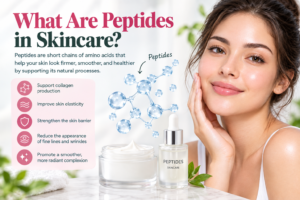
What Are Peptides in Skincare?
Peptides are short chains of amino acids, which are the building blocks of proteins. In skincare, specific peptides are formulated to interact with biological processes in the skin.
Proteins such as collagen and elastin are much larger structures. Peptides are considerably smaller, which allows certain peptide sequences to act as biological signals or participate in other processes.
In cosmetic formulations, peptides are commonly investigated or used for their potential effects on:
- Collagen-related activity
- Extracellular-matrix support
- Skin firmness
- Fine lines and wrinkles
- Skin texture
- Hydration and overall appearance
- Wound-healing-related processes
However, not every peptide does all of these things. A peptide’s sequence and chemical structure determine its biological activity.
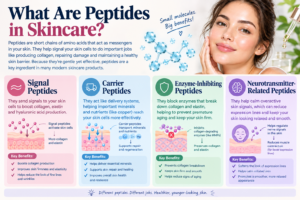
Research reviews commonly classify cosmetic peptides into groups such as signal peptides, carrier peptides, neurotransmitter-inhibiting peptides, and enzyme-inhibiting peptides.
What Are Peptides in Skincare?
The simplest way to understand peptides is to think of them as small biological messengers or functional molecules.
Some peptides may interact with skin cells and signal processes associated with the extracellular matrix. Others may bind to minerals or influence enzymes involved in skin-related pathways.
1. Signal Peptides
Signal peptides are designed to send signals that may encourage processes associated with the extracellular matrix.
Some have been studied for their potential to support collagen production or collagen-related activity.
For example, palmitoyl pentapeptide has been investigated in controlled clinical research. One study involving 93 women found that a topical formulation containing palmitoyl pentapeptide produced improvements in facial fine lines and wrinkles compared with the control moisturizer after 12 weeks.
That doesn’t mean every signal peptide will produce the same result. Different formulations and peptide sequences can behave very differently.
2. Carrier Peptides
Carrier peptides are intended to transport or bind certain substances, often minerals, that may be relevant to skin processes.
Copper peptides are a well-known example.
Their proposed role involves delivering copper ions and interacting with processes related to tissue repair and extracellular-matrix activity.
3. Enzyme-Inhibiting Peptides
Some peptides are designed to influence enzymes involved in the breakdown of proteins or other biological processes.
Because collagen degradation is one component of skin aging, researchers have investigated whether certain peptides can help influence pathways associated with collagen turnover.
4. Neurotransmitter-Related Peptides
Some cosmetic peptides are designed to influence pathways associated with facial muscle contraction.
These are sometimes marketed around the appearance of expression lines. However, topical peptides shouldn’t be treated as equivalent to medical procedures that directly affect muscle activity.
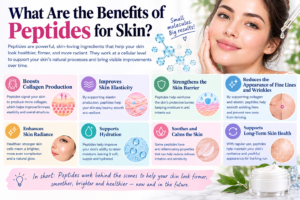
What Are the Benefits of Peptides for Skin?
The potential benefits of peptides for skin depend on the specific peptide and formulation.
Here are some of the most commonly researched benefits.
1. Peptides May Support Collagen Production
Collagen provides much of the structural framework of youthful-looking skin.
As skin ages, changes in collagen quantity and quality contribute to visible changes such as reduced firmness and wrinkles.
Certain signal peptides are designed to interact with pathways associated with collagen production or extracellular-matrix activity. This is one reason peptides are frequently included in anti-aging skincare.
However, it’s important not to interpret this as meaning that every peptide serum automatically increases collagen in a clinically meaningful way.
The evidence for topical peptides is mixed, and studies vary in formulation, peptide type, duration, and methodology. A systematic review of clinical studies found considerable limitations in the available research, including a lack of placebo controls and double-blinding in many studies.
2. Peptides May Help Improve the Appearance of Fine Lines
Peptides for fine lines and wrinkles are among the most common uses of peptide skincare.
Some controlled studies have reported improvements in wrinkle measurements after topical peptide use.
For example, research on palmitoyl pentapeptide found significant improvements in fine lines and wrinkles compared with a control product after 12 weeks.
A newer randomized clinical trial also investigated a specific cyclized hexapeptide formulation for signs of skin aging and reported improvements in several wrinkle measurements over 56 days.
These findings are encouraging, but they apply to the specific formulations studied—not automatically to every product containing “peptides.”
3. Peptides May Support Skin Firmness
Loss of collagen and changes in the extracellular matrix are associated with reduced skin firmness as skin ages.
Because certain peptides are designed to interact with collagen-related pathways, researchers have investigated their potential to improve the appearance of firmness and elasticity.
The results aren’t uniform, though. A 2026 systematic review and meta-analysis of randomized controlled trials found that peptide treatments showed benefits for several signs of skin aging, but effects on elasticity were less consistent. Importantly, only a small portion of the included participants were in topical-peptide studies, so the findings should not be interpreted as strong proof for all topical peptide products.
4. Peptides May Improve the Look of Skin Texture
Skin texture is influenced by hydration, the outer skin barrier, collagen structure, sun exposure, and many other factors.
Some peptide-containing formulations have been associated with improvements in the appearance of skin texture.
A study evaluating a peptide-rich cream alongside a hyaluronic-acid serum reported improvements in texture, tone, and lines and wrinkles over 12 weeks. Because the study used a combination regimen rather than a peptide product alone, however, the results can’t be attributed entirely to peptides.
5. Peptides May Support Skin Repair Processes
Some peptides have been investigated for their role in processes associated with tissue repair and regeneration.
This is one reason peptides are studied not only for cosmetic anti-aging products but also for broader dermatological applications.
Still, laboratory findings don’t always translate directly into visible improvements from an over-the-counter skincare product.
The formulation matters because peptides can have difficulty penetrating the skin’s outer barrier, and stability can also be an issue.
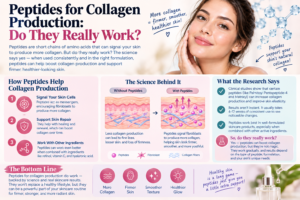
Peptides for Collagen Production: Do They Really Work?
This is one of the most common questions about peptide skincare.
Some peptides have been designed and studied for their ability to influence collagen-related pathways, and certain clinical studies have reported improvements in the appearance of wrinkles. However, the evidence is not strong enough to say that every topical peptide product significantly increases collagen in human skin.
There are several reasons for this.
Peptide type matters
“Peptides” isn’t one single ingredient.
A signal peptide, copper peptide, and neurotransmitter-related peptide can have completely different mechanisms.
Formulation matters
Two products containing the same peptide may not perform identically.
Factors such as:
- Concentration
- pH
- Stability
- Delivery system
- Other ingredients
- Packaging
- Storage
can affect how the ingredient behaves.
Skin penetration matters
The skin is designed to prevent substances from entering easily.
One major challenge with topical peptides is their relatively poor ability to cross the skin barrier. Researchers are investigating different delivery systems to improve peptide stability and bioavailability.
So, seeing a peptide high on an ingredient list doesn’t automatically tell you how effective the finished product will be.
Peptide Serum Benefits: What Can You Expect?
A peptide serum is usually a lightweight leave-on product containing one or more peptides.
Potential benefits can include:
- Smoother-looking skin
- Improved appearance of fine lines
- Support for firmer-looking skin
- Better overall skin texture
- Support for collagen-related processes
- Compatibility with many basic skincare routines
But expectations should remain realistic.
A peptide serum isn’t likely to transform your skin overnight.
Most skincare ingredients that affect visible signs of aging require consistent use over time, and clinical studies of peptide formulations have generally measured outcomes over several weeks rather than a few days.
Who Can Use Peptides in Skincare?
Peptides are commonly used in skincare routines for adults concerned about:
- Fine lines
- Loss of firmness
- Uneven skin texture
- Signs of skin aging
- Preventive skincare
- Maintaining a simple anti-aging routine
They’re also attractive to people who want to add an anti-aging ingredient without immediately turning to stronger actives.
However, having peptides in a routine doesn’t mean you should skip proven basics such as sun protection and moisturization.
How to Add Peptides to Your Skincare Routine
Adding a peptide product doesn’t need to make your routine complicated.
Morning routine
A simple routine might look like:
- Gentle cleanser
- Peptide serum
- Moisturizer
- Broad-spectrum sunscreen
Evening routine
You could use:
- Gentle cleanser
- Peptide serum
- Other treatment products, depending on your routine
- Moisturizer
If you’re using multiple active ingredients, introduce products gradually rather than adding several new products at once.
This makes it easier to identify which product is causing irritation if your skin reacts.
Can You Use Peptides With Other Skincare Ingredients?
In many routines, peptides can be combined with other commonly used skincare ingredients.
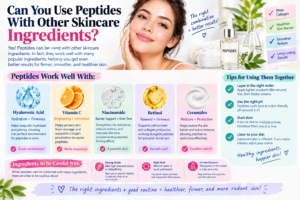
Peptides + Hyaluronic Acid
This is a popular combination because hyaluronic acid is primarily associated with hydration, while peptides are used for other skin-supporting functions.
Using both can create a routine that addresses different aspects of skin appearance.
Peptides + Niacinamide
Niacinamide and peptides have different functions, so they’re commonly included together in skincare routines.
Niacinamide is widely used for supporting the skin barrier, regulating oil production, and improving the appearance of uneven tone.
Peptides + Vitamin C
These ingredients may also appear in the same routine.
However, product formulation matters more than simply combining ingredient names. If you’re using a commercially formulated product, follow its directions and introduce new products gradually.
Peptides + Retinoids
Retinoids and peptides target skin aging through different mechanisms.
A routine may contain both, but retinoids can cause irritation, especially when someone is just starting them. If your skin is sensitive, introducing products one at a time is a practical approach.
Are Peptides Safe for Skin?
Topical peptides are generally considered well tolerated in cosmetic formulations, but any skincare ingredient can potentially cause irritation or an allergic reaction.
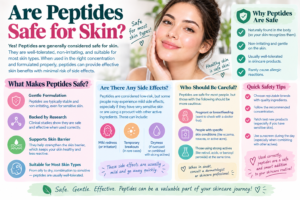
Your reaction depends on the complete formula—not simply the presence of peptides.
For example, a peptide serum may also contain:
- Fragrance
- Preservatives
- Botanical extracts
- Acids
- Essential oils
- Other active ingredients
If you have sensitive skin, patch testing a new product can help reduce the risk of an unexpected reaction.
Stop using a product if it causes persistent burning, swelling, significant redness, or other concerning symptoms.
Common Mistakes When Using Peptide Skincare
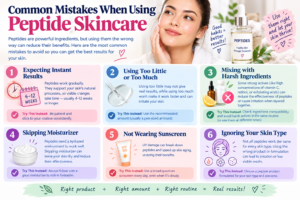
Mistake 1: Expecting Immediate Results
Peptides aren’t an overnight solution.
Visible changes in wrinkles or firmness generally take time, and results vary between products.
Mistake 2: Assuming All Peptides Are the Same
A product simply labeled “peptide serum” doesn’t tell you exactly what the peptides are designed to do.
Look at the actual ingredient list and product information.
Mistake 3: Ignoring Sunscreen
Peptides don’t replace sunscreen.
Ultraviolet radiation is a major contributor to premature skin aging, so daily sun protection remains an important part of an anti-aging routine.
Mistake 4: Using Too Many New Products at Once
Adding several serums simultaneously makes it difficult to know what’s helping—or irritating—your skin.
Introduce one new product at a time when possible.
Mistake 5: Believing Bigger Claims
Words such as “collagen boosting” or “anti-aging peptide complex” don’t automatically prove that a product will produce dramatic results.
The actual evidence depends on the specific peptide and finished formulation.
How to Choose a Peptide Skincare Product
You don’t necessarily need the most expensive product.
Instead, consider these factors:
1. Check the Ingredient List
Look for the specific peptide names rather than relying only on the word “peptide” on the front of the packaging.
2. Consider the Rest of the Formula
A good peptide product should also be suitable for your skin type and routine.
3. Avoid Overcomplicating Your Routine
More products don’t necessarily mean better results.
A basic routine containing cleanser, moisturizer, sunscreen, and a targeted treatment may be more practical than using numerous overlapping products.
4. Consider Your Main Skin Concern
If your primary concern is:
- Dryness: prioritize moisturizing and barrier-supporting ingredients.
- Sun damage: prioritize daily sunscreen.
- Fine lines: peptides may be one option among several.
- Acne: consider ingredients specifically supported for acne management.
- Sensitivity: keep the routine simple and avoid unnecessary irritants.
How Long Do Peptides Take to Work?
There’s no single timeline for every peptide product.
Clinical studies have evaluated different formulations over periods ranging from several weeks to a few months. For example, studies have reported results after four weeks, 12 weeks, and other treatment periods.
Your results can also depend on:
- The peptide used
- Product formulation
- Concentration
- Frequency of application
- Your skin condition
- Other products in your routine
- The specific outcome you’re measuring
It’s better to judge gradual changes over several weeks than expect a visible difference after a few applications.
Do Peptides Replace Retinol?
No.
Peptides and retinoids are different categories of skincare ingredients with different mechanisms.
Retinoids have a much larger body of research for photoaging and are often used to improve the appearance of fine lines, pigmentation, and skin texture. Peptides may serve as another option or complement within a broader routine.
One recent clinical trial investigated a specific cyclized peptide formulation against retinol and reported favorable results for that particular peptide. But a single study of a specific ingredient should not be interpreted as proving that peptides generally outperform retinoids.
Are Peptides Worth Adding to Your Skincare Routine?
Peptides can be a reasonable addition if your goal is to support smoother, firmer-looking skin and address early visible signs of aging.
The most important point is to have realistic expectations.
Peptides aren’t magic ingredients. Their performance varies considerably by peptide, formulation, and delivery system. Current research suggests that some topical peptides can improve certain signs of skin aging, but the evidence is not equally strong for every peptide or every product.
For most people, peptides make the most sense as one part of a complete skincare routine, rather than the foundation of the entire routine.
Frequently Asked Questions
1. What are peptides in skincare?
Peptides are short chains of amino acids used in skincare products for their potential biological effects. Depending on the type, they may signal processes associated with collagen and the extracellular matrix, bind certain substances, or influence other skin-related pathways.
2. What do peptides do for your skin?
Peptides may help support collagen-related activity and improve the appearance of fine lines, wrinkles, firmness, and skin texture. However, results depend on the specific peptide and formulation.
3. Do peptides increase collagen?
Some peptides are designed to stimulate or influence collagen-related pathways, and clinical studies of certain peptide formulations have shown improvements in wrinkles. However, it’s not accurate to assume that every topical peptide product significantly increases collagen in human skin.
4. Are peptides good for aging skin?
They can be useful for people concerned about visible signs of skin aging. Research suggests that certain peptides may improve aspects of wrinkles and skin appearance, although the strength of evidence varies between peptide types and products.
5. Can I use peptides every day?
Many peptide skincare products are designed for regular use, often once or twice daily. Always follow the instructions for the specific product, especially if it contains other active ingredients.
6. Can peptides be used with retinol?
Peptides and retinol can be included in the same overall skincare routine. If you’re new to retinol, introduce it gradually because irritation is more likely to come from the retinoid than from the peptide itself.
7. Can peptides help fine lines and wrinkles?
Certain topical peptides have shown potential for improving the appearance of fine lines and wrinkles in clinical studies. Results vary, and not every peptide has the same evidence behind it.
8. Are peptide serums suitable for sensitive skin?
Many peptide formulations are well tolerated, but sensitivity depends on the entire product formula. If your skin is reactive, check the ingredient list and consider patch testing before applying a new product broadly.
9. How long do peptide skincare products take to work?
There isn’t one fixed timeline. Clinical studies of individual peptide formulations have reported outcomes after several weeks of consistent use, but individual results can vary.
10. Should I use peptides or hyaluronic acid?
They serve different purposes. Hyaluronic acid is mainly used to support hydration, while peptides are used for a range of biological and cosmetic effects. They can be used together if the products suit your skin and routine.
Key Takeaways
- Peptides are short chains of amino acids used in skincare for different biological functions.
- Some peptides are designed to signal collagen-related activity.
- Others work as carrier, enzyme-inhibiting, or neurotransmitter-related peptides.
- Research suggests certain peptides can improve the appearance of fine lines and wrinkles.
- Results depend heavily on the specific peptide and formulation.
- Topical peptide research is promising, but limitations remain, particularly around skin penetration and study quality.
- Peptides can complement ingredients such as hyaluronic acid, niacinamide, vitamin C, and retinoids.
- Sunscreen remains essential for protecting skin from UV-related aging.
- Consistent use and realistic expectations matter more than simply choosing a product because it contains “peptides.”
Final Thoughts
Peptides in skincare are more than a marketing buzzword, but they’re also not a miracle ingredient.
Certain peptide sequences have biological functions that may support collagen-related pathways, skin structure, and the visible appearance of aging. Clinical research has reported improvements in wrinkles and other skin-aging measures for some specific formulations. At the same time, researchers continue to point out important limitations, particularly differences between peptide types, formulations, delivery systems, and study designs.
If you’re interested in peptide skincare, focus on the specific ingredient, the quality of the formulation, and your overall routine rather than choosing a product simply because the label says “peptide.”
For healthy-looking skin, peptides work best as part of a consistent routine that also includes appropriate cleansing, moisturization, and daily sun protection.