
A natural beauty routine using ingredients from your kitchen can be simple, affordable, and useful for basic skin and hair care. Common ingredients such as oatmeal, honey, yogurt, aloe vera, and coconut oil can be used in simple homemade treatments. However, natural doesn’t automatically mean safe for everyone, so patch testing and choosing gentle ingredients are important.
What Is a Natural Beauty Routine Using Kitchen Ingredients?
A natural beauty routine using kitchen ingredients is a simple approach to personal care that incorporates commonly available foods or plant-based ingredients into homemade skincare and hair-care treatments.
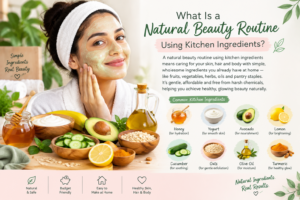
Instead of using many products, you can build a basic routine around a few gentle steps:
- Cleansing the skin
- Gentle exfoliation when appropriate
- Moisturizing
- Occasional face masks
- Basic hair conditioning
- Body care
The goal isn’t to replace every beauty product with food from your kitchen. It’s about using suitable ingredients thoughtfully while avoiding ingredients that can irritate or damage the skin.
Why Try a Kitchen-Based Beauty Routine?
Kitchen ingredients can be convenient because many are already available at home. A simple routine can also help you understand exactly what you’re putting on your skin.

Potential advantages include:
- Fewer ingredients in homemade treatments
- Convenient access to common ingredients
- Low-cost options for occasional treatments
- Simple preparation
- The ability to customize treatments for your skin type
Still, homemade skincare has limitations. Food ingredients aren’t formulated, preserved, or tested in the same way as cosmetic products. Some can cause irritation, allergic reactions, or breakouts.
Best Kitchen Ingredients for Natural Beauty
Not every kitchen ingredient belongs on your face. Focus on relatively gentle options and use them appropriately.
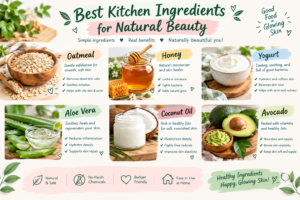
1. Oatmeal
Finely ground oatmeal can be useful in gentle cleansing or soothing preparations. It can help remove surface debris without the harsh feel of rough scrubs.
Simple idea: Mix finely ground plain oats with water to create a soft paste. Apply gently, then rinse without vigorous rubbing.
2. Honey
Honey is commonly used in homemade face masks because it has humectant properties, meaning it can help attract and retain moisture.
For a simple treatment, apply a thin layer of plain honey to clean skin for a short period and rinse thoroughly.
Choose plain honey rather than a flavored or heavily processed mixture.
3. Yogurt
Plain yogurt contains lactic acid, an alpha hydroxy acid (AHA) that can provide mild exfoliating effects.
However, acidic ingredients can irritate sensitive skin. If you use yogurt as a homemade treatment, keep the application brief and stop if you experience burning or significant redness.
4. Aloe Vera
If you have a suitable aloe vera product or fresh aloe from a known safe source, aloe can be used as a soothing skin-care ingredient.
Fresh aloe should be prepared carefully because the yellow latex portion of the plant can irritate the skin. Avoid applying unknown plant material directly to your face.
5. Coconut Oil
Coconut oil can work as a body moisturizer for some people because it helps reduce moisture loss from the skin.
It may not be suitable for acne-prone facial skin because it can feel heavy and may contribute to clogged pores for some individuals.
6. Avocado
Mashed avocado is sometimes used in homemade moisturizing masks because it contains fats and other nutrients.
It’s best viewed as an occasional beauty treatment rather than a necessary part of daily skincare.
A Simple Natural Face Care Routine at Home
You don’t need a complicated DIY skincare routine. A basic routine can look like this.
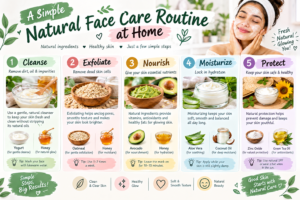
Step 1: Cleanse Gently
Start with a gentle facial cleanser to remove sweat, oil, sunscreen, makeup, and dirt.
Although some kitchen ingredients can be used in homemade treatments, they’re not always good substitutes for a properly formulated cleanser.
Step 2: Use a Gentle DIY Treatment
Once or twice a week, you can use a simple homemade mask if your skin tolerates it.
For example:
Oatmeal and Honey Mask
- 1 tablespoon finely ground oatmeal
- 1 teaspoon plain honey
- A small amount of water
Mix until you have a soft paste. Apply gently to clean skin, avoiding the eye area. Leave it on for a short time and rinse with lukewarm water.
Don’t scrub the mixture aggressively.
Step 3: Moisturize
After washing your face, apply a moisturizer suited to your skin type.
If you’re prone to acne or clogged pores, a lightweight, non-comedogenic moisturizer may be more appropriate than kitchen oils.
Step 4: Apply Sunscreen During the Day
A natural beauty routine shouldn’t mean skipping sun protection.
Use a broad-spectrum sunscreen during daytime exposure. Homemade ingredients cannot provide reliable, tested sunscreen protection.
Natural Beauty Routine for Dry Skin
Dry skin usually benefits from gentle cleansing and consistent moisturization.
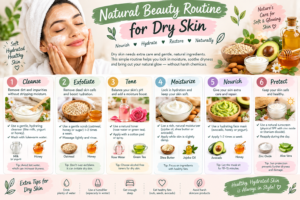
A simple routine could include:
Morning
- Gentle cleanser
- Moisturizer
- Broad-spectrum sunscreen
Evening
- Gentle cleanser
- Moisturizer
- Optional oatmeal or honey treatment once or twice weekly
Avoid using rough sugar or salt scrubs on dry facial skin. They can cause irritation and microscopic skin damage from excessive friction.
Natural Beauty Routine for Oily Skin
If your skin becomes oily easily, avoid assuming that harsh DIY treatments are the solution.
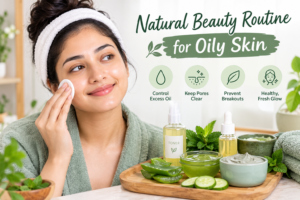
A simple routine includes:
- Gentle cleanser
- Lightweight moisturizer
- Sunscreen during the day
- Occasional gentle treatment
Avoid applying large amounts of coconut oil or other heavy oils to an oily, acne-prone face.
Natural Beauty Routine for Sensitive Skin
Sensitive skin needs extra caution.
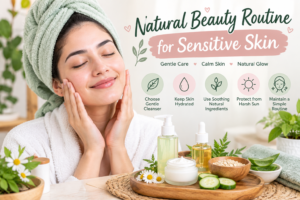
Before using a new homemade treatment:
- Test a small amount on a limited area first.
- Use one new ingredient at a time.
- Avoid strong acids and essential oils.
- Don’t scrub irritated skin.
- Stop immediately if you experience burning, swelling, or significant redness.
If your skin regularly reacts to products or ingredients, professionally formulated fragrance-free products may be easier to manage than homemade mixtures.
Kitchen Ingredients for Hair Care
Some kitchen ingredients can also be used for simple hair treatments.
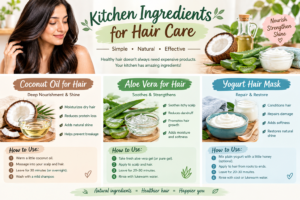
Coconut Oil for Hair
Coconut oil can be used as a pre-wash treatment for some hair types. Apply a small amount to the lengths and ends, leave it for a suitable period, and shampoo afterward.
You don’t need to soak your entire scalp in oil.
Aloe Vera for Hair
Aloe-based treatments may feel soothing on the scalp for some people, but they aren’t a proven cure for hair loss or other scalp disorders.
If you have persistent itching, scaling, inflammation, or unusual hair shedding, it’s better to identify the underlying cause rather than relying on DIY treatments.
Yogurt Hair Mask
Plain yogurt is sometimes used as a homemade conditioning mask.
You can apply a small amount to the lengths of damp hair, leave it briefly, and rinse thoroughly before shampooing if needed.
The main benefit is the conditioning experience—not a guaranteed treatment for hair growth or damage.
Kitchen Ingredients You Should Be Careful With
Some popular DIY beauty ingredients can do more harm than good.

Lemon Juice
Applying lemon juice directly to the skin can cause irritation and increase sensitivity to sunlight. It’s not a good choice for homemade facial treatments.
Baking Soda
Baking soda is alkaline, while healthy skin has a naturally acidic environment. Using baking soda on the face can disrupt the skin barrier and cause irritation.
Undiluted Apple Cider Vinegar
Apple cider vinegar is acidic and can cause burning or irritation when applied directly to skin.
Sugar and Salt Scrubs
Large, rough particles can be too abrasive for facial skin. Scrubbing harder doesn’t make exfoliation more effective.
Essential Oils
“Natural” doesn’t mean risk-free. Essential oils are highly concentrated and can trigger irritation or allergic reactions, especially when applied improperly.
How to Patch Test Homemade Beauty Remedies
Patch testing is a simple precaution before trying a new ingredient.
- Apply a small amount to a limited area of skin.
- Leave it according to the intended treatment instructions.
- Wash it off if irritation develops.
- Observe the area afterward.
- Don’t use the ingredient if you develop significant redness, itching, swelling, or burning.
A small test cannot guarantee that you’ll never react, but it can help reduce unnecessary exposure.
Common Mistakes With DIY Beauty Routines
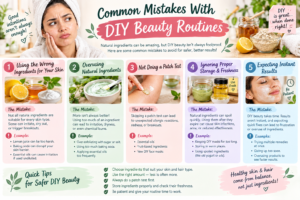
Using Too Many Ingredients
Combining honey, lemon, yogurt, baking soda, oils, and other ingredients doesn’t make a treatment more effective.
Start with one or two suitable ingredients.
Scrubbing Too Hard
Physical exfoliation should never hurt. Aggressive rubbing can irritate the skin barrier.
Using DIY Treatments Every Day
More isn’t necessarily better. Occasional treatments are usually more sensible than repeatedly exposing your skin to homemade mixtures.
Assuming Natural Means Safe
Poisonous plants are natural. So are allergens and irritating substances.
Always consider how an ingredient interacts with your skin rather than relying on the word “natural.”
Storing Homemade Products Too Long
Homemade mixtures containing water, dairy, fruits, or other fresh ingredients can spoil or become contaminated.
It’s safer to prepare small amounts and avoid keeping homemade skincare mixtures around for long periods.
Tips for a Safer Natural Skincare Routine at Home
Keep your routine simple.
- Choose plain, minimally processed ingredients.
- Use clean bowls, spoons, and hands.
- Prepare small quantities.
- Avoid applying food ingredients to broken or irritated skin.
- Patch test unfamiliar ingredients.
- Don’t use kitchen mixtures as a replacement for sunscreen.
- Avoid DIY treatments around the eyes.
- Stop if you develop irritation.
- Keep your regular cleanser and moisturizer if they work well for you.
- Seek professional advice for persistent skin or scalp problems.
Key Takeaways
- A kitchen-based beauty routine can provide simple occasional treatments.
- Oatmeal, honey, yogurt, aloe vera, and coconut oil are examples of commonly used ingredients.
- Not every food ingredient is appropriate for facial skin.
- Lemon juice, baking soda, harsh scrubs, and undiluted acidic ingredients can cause irritation.
- Natural ingredients aren’t automatically safe.
- Patch testing is a useful precaution.
- Homemade treatments shouldn’t replace sunscreen or appropriate treatment for persistent skin conditions.
- A simple routine is generally easier to maintain than a complicated DIY regimen.
Frequently Asked Questions
Can I use kitchen ingredients on my face every day?
It’s generally better not to use homemade treatments every day. Some ingredients can irritate the skin when used repeatedly. Keep DIY treatments occasional and maintain a basic routine of gentle cleansing, moisturizing, and sun protection.
What is the best kitchen ingredient for glowing skin?
There isn’t one kitchen ingredient that guarantees glowing skin. Oatmeal, honey, and plain yogurt are commonly used in homemade treatments, but results vary between individuals. Consistent basic skincare and sun protection matter more than any single DIY ingredient.
Is honey good for a natural beauty routine?
Honey can be used as an occasional skincare ingredient because it has humectant properties. However, it can still cause irritation or allergic reactions in some people, so patch testing is sensible.
Can I use lemon juice for natural skincare?
Direct application of lemon juice isn’t recommended. Its acidity can irritate the skin, and citrus compounds can contribute to sun-related skin reactions.
Is coconut oil good for the face?
Coconut oil can moisturize the body and may be useful for some hair-care routines. On the face, however, it may be too heavy for some people and can contribute to clogged pores, particularly if you’re acne-prone.
How often should I use a homemade face mask?
For many people, once a week or occasionally is enough. Your skin type and the ingredients used matter. If a treatment causes dryness, burning, or irritation, stop using it.
Can kitchen ingredients replace skincare products?
Not completely. Homemade ingredients can be used for occasional treatments, but properly formulated products are generally more reliable for cleansing, moisturizing, sunscreen protection, and treating specific skin concerns.
Are natural beauty remedies safe for sensitive skin?
Not necessarily. Sensitive skin may react to natural ingredients just as it can react to cosmetic ingredients. Use extra caution, avoid harsh ingredients, and patch test before applying a new treatment.
Can I use homemade ingredients for hair growth?
Kitchen ingredients shouldn’t be considered proven hair-growth treatments simply because they’re natural. Hair loss can have many causes, and persistent or sudden shedding deserves proper evaluation.
Can I store homemade skincare mixtures?
It’s better to make small amounts and use them promptly. Fresh ingredients can spoil or become contaminated, particularly when water or dairy is involved.
Final Thoughts
A natural beauty routine using ingredients from your kitchen can be a simple way to enjoy occasional DIY skincare and hair-care treatments. The key is to keep expectations realistic and choose ingredients carefully.
You don’t need a complicated recipe to care for your skin. A gentle cleanser, suitable moisturizer, daily sunscreen, and occasional well-tolerated homemade treatment can be a much more practical approach than constantly experimenting with new ingredients.
Most importantly, remember that natural doesn’t automatically mean gentle or safe. Listen to your skin, patch test new ingredients, and stop any treatment that causes irritation.