
Sensitive skin can react easily to skincare products, makeup, weather changes, friction, or overuse of active ingredients. The best approach is to keep your routine gentle, simple, and consistent. Choose fragrance-free products when possible, introduce new products one at a time, moisturize regularly, and protect your skin from the sun. If irritation is persistent or severe, consult a dermatologist.
What Is Sensitive Skin?
Sensitive skin isn’t a medical diagnosis. It’s a term people commonly use when their skin frequently feels irritated, burns, stings, becomes itchy, or turns red after exposure to certain products or environmental conditions.
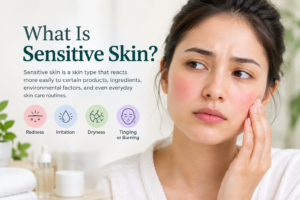
Some people have naturally reactive skin, while others develop sensitivity because of a damaged skin barrier, excessive exfoliation, very dry skin, certain skin conditions, or environmental exposure.
Common signs include:
- Redness or flushing
- Burning or stinging
- Itching
- Dryness or tightness
- Flaking
- Rough or uncomfortable skin
- Reactions after using certain skincare or makeup products
Sensitive skin can also vary from one person to another. A product that feels perfectly comfortable for one person may cause irritation in another.
Why Does Sensitive Skin Need a Gentle Beauty Routine?
Sensitive skin generally benefits from reducing unnecessary irritation. Using too many products, frequently changing your routine, scrubbing aggressively, or combining several strong ingredients can make discomfort worse.

A simple routine helps you identify what your skin tolerates and gives the skin barrier fewer things to react to.
A basic routine can focus on:
- Gentle cleansing
- Regular moisturizing
- Daily sun protection
- Minimal unnecessary exfoliation
- Careful product introduction
The goal isn’t to use the fewest products possible. It’s to use products that serve a purpose without unnecessarily irritating your skin.
Beauty Tips for Women With Sensitive Skin
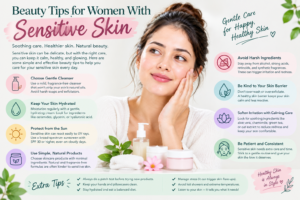
1. Keep Your Skincare Routine Simple
One of the most useful sensitive skin beauty tips is to avoid building an overly complicated routine.
You don’t necessarily need a cleanser, toner, several serums, multiple exfoliants, masks, oils, and other treatments every day.
A simple routine may include:
Morning
- Gentle cleanser or a water rinse if appropriate for your skin
- Moisturizer
- Broad-spectrum sunscreen
Evening
- Gentle cleanser
- Moisturizer
- One targeted treatment only if your skin tolerates it
Keeping your routine simple also makes it easier to identify which product may be causing a reaction.
2. Choose Gentle Cleansers
Cleansing removes sweat, oil, makeup, sunscreen, and environmental debris, but overly harsh cleansing can leave sensitive skin feeling tight or uncomfortable.
Look for a cleanser that:
- Cleans without leaving the skin extremely dry
- Doesn’t cause burning or stinging
- Is appropriate for your skin type
- Can be rinsed away easily
- Doesn’t require vigorous rubbing
Use lukewarm rather than very hot water. After washing, gently pat your face dry instead of rubbing it with a towel.
3. Moisturize Regularly
Moisturizer is an important part of a beauty routine for sensitive skin because keeping the skin hydrated can help support the skin barrier.
Look for products designed for sensitive or easily irritated skin. Ingredients such as ceramides, glycerin, and hyaluronic acid may be useful depending on the product and your individual tolerance.
If a moisturizer consistently causes burning, redness, or itching, stop using it rather than trying to push through the reaction.
4. Wear Sunscreen Every Day
Sun exposure can contribute to irritation, redness, and long-term skin damage.
A broad-spectrum sunscreen can help protect your skin from ultraviolet radiation. If you have sensitive skin, pay attention to how your skin responds to different sunscreen formulations.
Some people find certain mineral sunscreen formulations more comfortable, while others tolerate chemical sunscreen formulations without problems. There’s no single sunscreen type that’s best for everyone with sensitive skin.
Apply sunscreen as the final step of your morning skincare routine and reapply as appropriate for prolonged outdoor exposure.
5. Patch-Test New Products
Before applying a new skincare product widely, test a small amount on a limited area of skin.
This can help you identify obvious irritation before using the product on your entire face.
A simple approach is:
- Apply a small amount to a limited area.
- Follow the product’s directions.
- Observe your skin for signs of irritation.
- Don’t introduce several new products at the same time.
Patch testing isn’t a guarantee that you’ll never experience a reaction, but it can be a useful precaution.
Skincare Tips for Sensitive Skin
Use Fragrance-Free Products When Possible
Fragrance can irritate some people with sensitive skin. If your skin reacts easily, fragrance-free products may be a reasonable starting point.

Be careful with the terms “fragrance-free” and “unscented.” They don’t necessarily mean the same thing. An unscented product may contain ingredients intended to mask other odors.
Read the ingredient list rather than relying only on marketing language.
Avoid Over-Exfoliating
Exfoliation can remove surface dead skin cells, but more isn’t necessarily better.
Frequent use of strong exfoliating acids, scrubs, or other exfoliating treatments may leave sensitive skin irritated.
If you use an exfoliating product, introduce it cautiously and pay attention to how your skin responds.
Signs that you’re exfoliating too aggressively can include:
- Persistent redness
- Burning
- Increased dryness
- Peeling
- Tightness
- Greater sensitivity to products
If these symptoms appear, simplify your routine and give your skin time to recover.
Be Careful With Active Ingredients
Retinoids, exfoliating acids, benzoyl peroxide, and other active ingredients can be useful for specific skin concerns, but they aren’t automatically suitable for everyone.
Sensitive skin doesn’t mean you can never use active ingredients. It means you may need to introduce them more carefully.
Avoid starting several active ingredients simultaneously. Introduce one product at a time so you can understand how your skin reacts.
Don’t Scrub Your Face
Physical scrubs, rough washcloths, cleansing brushes, and aggressive rubbing can create unnecessary friction.
Instead:
- Use your fingertips when cleansing.
- Use gentle pressure.
- Rinse thoroughly.
- Pat your skin dry.
- Avoid picking or scratching irritated areas.
Gentle handling is one of the simplest skincare tips for sensitive skin.
Best Skincare Routine for Sensitive Skin
A good routine doesn’t have to contain many steps.
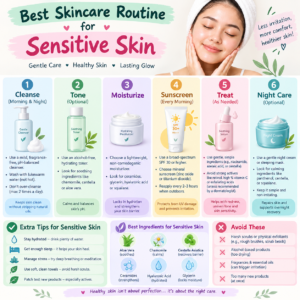
Morning Routine
Step 1: Cleanse
Use a gentle cleanser if your skin needs cleansing in the morning.
Step 2: Moisturize
Apply a moisturizer suited to your skin’s needs.
Step 3: Sunscreen
Finish with broad-spectrum sunscreen.
Evening Routine
Step 1: Remove Makeup and Sunscreen
Use a gentle makeup-removing or cleansing method that your skin tolerates.
Step 2: Cleanse
Wash away remaining residue with a gentle cleanser.
Step 3: Treatment
If you use a treatment product, apply it according to its directions and your skin’s tolerance.
Step 4: Moisturize
Finish with moisturizer to help maintain comfortable, hydrated skin.
Makeup Tips for Sensitive Skin
Sensitive skin doesn’t mean you have to avoid makeup. The key is to reduce unnecessary irritation and pay attention to product compatibility.

1. Start With Well-Moisturized Skin
Applying makeup over very dry or irritated skin can make the complexion look flaky and uneven.
Allow your moisturizer to settle before applying makeup.
2. Don’t Apply Makeup to Severely Irritated Skin
If your skin is actively burning, swollen, cracked, or significantly inflamed, adding makeup may make the area more uncomfortable.
Give irritated skin a break when necessary.
3. Choose Makeup Products Carefully
When looking for makeup products for sensitive skin, consider:
- Fragrance-free formulas
- Products labeled for sensitive skin
- Simple formulations when appropriate
- Products that don’t repeatedly cause irritation
However, “for sensitive skin” doesn’t guarantee that a product will work for everyone. Ingredients can affect people differently.
4. Clean Makeup Brushes Regularly
Dirty brushes and sponges can accumulate makeup residue, oil, and microorganisms.
Clean your makeup tools regularly according to the manufacturer’s recommendations. Allow them to dry completely before storing them.
Also avoid sharing eye and lip makeup with other people.
5. Remove Makeup Before Bed
Leaving makeup on overnight can contribute to irritation and clogged pores for some people.
Use a gentle removal method rather than rubbing aggressively.
If removing waterproof makeup requires excessive rubbing, consider a remover designed to dissolve it more easily.
Natural Beauty Tips for Sensitive Skin
“Natural” doesn’t automatically mean “gentle.”
Essential oils, botanical extracts, fragrances, and homemade ingredients can still irritate sensitive skin.

If you prefer natural beauty products, focus on tolerance rather than the word “natural.”
Useful habits include:
- Introduce one new ingredient at a time.
- Patch-test unfamiliar products.
- Avoid applying acidic kitchen ingredients directly to the face.
- Don’t assume DIY means safer.
- Stop using anything that causes irritation.
Your skin doesn’t care whether an ingredient came from a plant or a laboratory. What matters is how your skin responds to the finished product.
Ingredients That May Be Helpful for Sensitive Skin
There isn’t one perfect ingredient list for everyone. Still, certain ingredients are commonly used in products intended to support hydration and the skin barrier.

Ceramides
Ceramides are lipids naturally found in the skin and are commonly used in moisturizers designed to support the skin barrier.
Glycerin
Glycerin is a humectant that helps attract and retain water in the outer layers of the skin.
Hyaluronic Acid
Hyaluronic acid is a humectant used in many hydrating skincare products. Some people with sensitive skin tolerate it well, especially in a suitable moisturizing formula.
Colloidal Oatmeal
Colloidal oatmeal is used in skincare products designed to soothe and moisturize dry or irritated skin.
Remember that even commonly tolerated ingredients can cause problems for an individual person.
Ingredients and Habits to Approach Carefully
Not every potentially irritating ingredient is universally bad. Your skin’s tolerance matters.

- Strong exfoliating acids
- Retinoids when first starting
- Highly fragranced products
- Essential oils
- Alcohol-heavy formulas that feel drying
- Abrasive scrubs
- Very hot water
- Frequent product switching
If a product repeatedly causes discomfort, there’s little reason to keep using it simply because it’s popular.
How to Care for Sensitive Skin in Different Seasons

Summer
Heat, sweat, humidity, and sun exposure can make sensitive skin uncomfortable.
Try to:
- Keep cleansing gentle.
- Avoid unnecessary heavy layers.
- Use sunscreen consistently.
- Rinse sweat away when needed.
- Avoid rubbing your face repeatedly.
Winter
Cold air, low humidity, and indoor heating can contribute to dryness.
Consider:
- Using a richer moisturizer if your skin needs it.
- Avoiding very hot showers.
- Keeping showers reasonably short.
- Moisturizing after cleansing.
- Reducing harsh exfoliation.
Common Mistakes to Avoid

Changing Too Many Products at Once
If you introduce five new products and your skin reacts, it becomes difficult to identify the problem.
Introduce products gradually.
Following Every Beauty Trend
A popular skincare trend isn’t necessarily appropriate for sensitive skin.
Ask whether your skin actually needs the product before adding it.
Using Too Many Active Ingredients
Combining multiple powerful treatments can increase irritation.
Keep your routine manageable.
Ignoring Early Signs of Irritation
Mild stinging or redness shouldn’t always be dismissed as “your skin adjusting.”
If a product consistently causes discomfort, stop and reassess.
Using Very Hot Water
Hot water can worsen dryness and discomfort in some people.
Lukewarm water is generally a gentler choice.
Assuming Expensive Means Better
Price doesn’t determine whether a product will suit sensitive skin.
A simpler product that your skin tolerates may be more useful than a complicated, expensive routine.
How to Build a Sensitive Skin Care Routine for Women
If you’re starting from scratch, don’t try to solve every skin concern at once.

Week 1: Establish the Basics
Start with:
- Gentle cleanser
- Moisturizer
- Sunscreen
Give yourself time to see how your skin responds.
Next: Add One Product
If you want to address a particular concern, introduce one additional product.
For example, don’t introduce a new exfoliant, retinoid, serum, and mask during the same week.
Monitor Your Skin
Pay attention to:
- Redness
- Burning
- Itching
- Dryness
- Breakouts
- Peeling
Keep notes if necessary. A simple record can help you identify patterns.
When Should You See a Dermatologist?
Sensitive skin can sometimes overlap with conditions such as eczema, rosacea, contact dermatitis, or other skin disorders.
Consider seeking professional advice if you experience:
- Persistent redness
- Repeated burning or stinging
- Significant itching
- Swelling
- Cracked or bleeding skin
- Reactions to many different products
- A rash that doesn’t improve
- Symptoms that interfere with daily life
A dermatologist can help determine whether there’s an underlying skin condition and recommend an appropriate treatment plan.
Key Takeaways
- Keep your beauty routine simple and consistent.
- Use gentle cleansing and moisturization.
- Wear broad-spectrum sunscreen.
- Introduce new products one at a time.
- Patch-test when appropriate.
- Don’t over-exfoliate.
- Be cautious with strong active ingredients.
- Fragrance-free products may be helpful for people who are sensitive to fragrance.
- “Natural” doesn’t automatically mean gentle.
- Stop using products that repeatedly cause irritation.
- Seek professional advice for persistent or severe reactions.
Frequently Asked Questions
1. What are the best beauty tips for women with sensitive skin?
The most useful approach is to keep your routine gentle and simple. Cleanse without excessive rubbing, moisturize regularly, use sunscreen, avoid unnecessary exfoliation, introduce products gradually, and pay attention to ingredients that have caused problems for you in the past.
2. What is the best skincare routine for sensitive skin?
A basic routine usually includes gentle cleansing, moisturizing, and daytime sun protection. Additional treatments can be added gradually when needed and tolerated. There’s no universal routine because sensitive skin can have different causes and triggers.
3. Is fragrance bad for sensitive skin?
Fragrance isn’t necessarily a problem for everyone, but it can trigger irritation or allergic reactions in some people. If your skin reacts easily, choosing fragrance-free products can reduce one potential source of irritation.
4. Can women with sensitive skin wear makeup?
Yes. Many people with sensitive skin can wear makeup comfortably. Choose products your skin tolerates, avoid applying makeup over severely irritated areas, keep brushes clean, and remove makeup gently.
5. How often should sensitive skin be exfoliated?
There isn’t a universal schedule. Some people with sensitive skin may need little or no exfoliation, while others may tolerate occasional gentle exfoliation. If exfoliation causes burning, redness, peeling, or persistent dryness, reduce or stop it.
6. Are natural skincare products better for sensitive skin?
Not necessarily. Natural ingredients can still cause irritation or allergic reactions. Instead of choosing a product simply because it’s natural, consider its ingredients, formulation, and how your skin responds.
7. What ingredients are good for sensitive skin?
Ingredients such as ceramides, glycerin, hyaluronic acid, and colloidal oatmeal are commonly used in products for hydration and skin-barrier support. However, individual tolerance matters more than any universal ingredient list.
8. How can I test a new skincare product?
Apply a small amount to a limited area according to the product’s directions and observe how your skin responds. Introducing only one new product at a time can make it easier to identify potential triggers.
9. Why does my skin sting after applying skincare products?
Stinging can occur when your skin barrier is irritated, when a product contains an ingredient your skin doesn’t tolerate, or when the skin is already compromised. Persistent or significant stinging is a reason to stop the product and reassess your routine.
10. What should I do if my sensitive skin keeps reacting?
Simplify your routine and stop products that appear to trigger reactions. If reactions continue despite a gentle routine, or if you develop significant redness, swelling, itching, or a persistent rash, consult a dermatologist.
Conclusion
Caring for sensitive skin is less about finding a perfect collection of beauty products and more about avoiding unnecessary irritation. A gentle cleanser, moisturizer, sunscreen, careful product introduction, and consistent habits can form a strong foundation.
The most important rule is to listen to your skin. What works beautifully for someone else may not work for you. Keep your routine practical, introduce changes slowly, and seek professional guidance when reactions are persistent or severe.
That approach makes beauty care more comfortable, predictable, and sustainable for sensitive skin.