
Knowing how to identify your hair type helps you choose the right shampoo, conditioner, styling products, and care routine. Your curl pattern determines hair type, while texture, density, porosity, thickness, and elasticity also affect how your hair behaves. Understanding these characteristics leads to healthier, easier-to-manage hair.
Takeaway: Learning your hair type is the first step toward creating an effective hair care routine.
Introduction
Every person’s hair is unique. Some people have silky straight hair that stays smooth all day, while others have beautiful curls or tight coils that require extra moisture and care. Yet many women buy hair products without truly understanding what their hair needs.
The result? Dryness, frizz, breakage, limp hair, or excessive oiliness.
Fortunately, identifying your hair type isn’t difficult. Once you understand your hair’s natural characteristics, choosing products and building the right routine becomes much easier.
This guide explains everything you need to know—from curl patterns and texture to porosity and density—so you can confidently care for your hair.
Why Knowing Your Hair Type Matters
Knowing your hair type helps you select products and styling techniques that work with your natural hair instead of against it. It can reduce damage, improve moisture balance, minimize frizz, and make daily styling faster and easier.
Hair products are not one-size-fits-all. A shampoo designed for oily straight hair may leave curly hair dry. Likewise, heavy creams that nourish coily hair can weigh down fine straight hair.
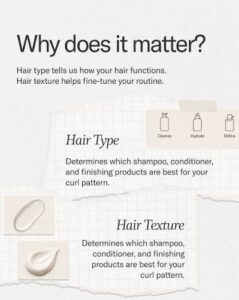
Understanding your hair type helps you:
- Choose the right shampoo
- Select an effective conditioner
- Reduce breakage
- Control frizz
- Improve curl definition
- Avoid product buildup
- Protect hair from damage
- Save money by buying products that actually work
Example
If your hair is naturally curly, lightweight moisturizing products usually perform better than harsh clarifying shampoos used every day.
If your hair is straight and oily, heavy oils may leave it looking greasy.
Takeaway: The better you know your hair, the better you can care for it.
What Determines Your Hair Type?
Hair type is mainly determined by your natural curl pattern, which is influenced by genetics. However, texture, thickness, density, porosity, and elasticity also affect how your hair looks, feels, and responds to products and styling.
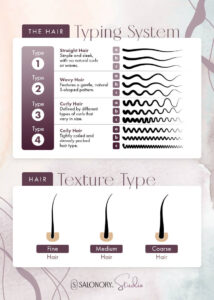
Several characteristics work together.
| Hair Characteristic | What It Means |
|---|---|
| Curl Pattern | Straight, wavy, curly, or coily |
| Texture | Fine, medium, or coarse |
| Density | Amount of hair on your scalp |
| Porosity | How well hair absorbs moisture |
| Thickness | Width of each hair strand |
| Elasticity | Ability to stretch without breaking |
Each characteristic influences your routine.
Takeaway: Hair type is only one part of understanding your hair’s needs.
The Four Main Hair Types
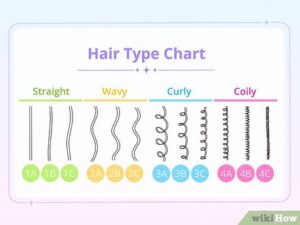
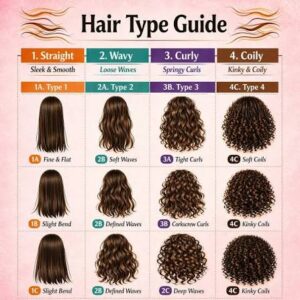
Hair professionals generally classify hair into four main categories: straight, wavy, curly, and coily. Each type has different moisture needs, styling challenges, and recommended products.
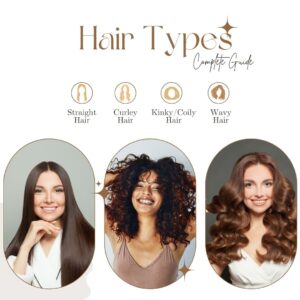
Type 1: Straight Hair
Straight hair grows without visible waves or curls.
Characteristics
- Naturally smooth
- Reflects light well
- Often appears shiny
- Oil travels easily from scalp to ends
- Can become oily quickly
Advantages
- Easy to brush
- Simple to style
- Less prone to tangling
Challenges
- Can become greasy
- May lack volume
- Difficult to hold curls
Best Products
- Lightweight shampoo
- Volumizing conditioner
- Dry shampoo
- Lightweight styling spray
Takeaway: Straight hair benefits from lightweight products that add volume without excess oil.
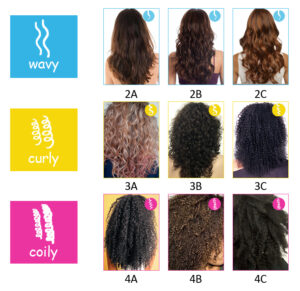
Type 2: Wavy Hair
Wavy hair forms gentle “S” shapes.
It falls between straight and curly hair.
Characteristics
- Natural movement
- Moderate volume
- Slight frizz
- Can become flat at the roots
Type 2A
- Loose waves
- Very soft
- Easy to straighten
Type 2B
- More defined waves
- Moderate frizz
- Holds styles better
Type 2C
- Thick waves
- Strong “S” pattern
- Almost curly
Best Products
- Curl-enhancing cream
- Lightweight mousse
- Moisturizing conditioner
- Anti-frizz serum
Takeaway: Wavy hair thrives with lightweight moisture and frizz control.
Type 3: Curly Hair
Curly hair forms spiral-shaped curls.
Natural oils have a harder time reaching the ends, making curly hair more prone to dryness.
Characteristics
- Defined curls
- Higher volume
- More frizz
- Needs hydration
- Can shrink after washing
Type 3A
- Loose curls
- Large spirals
- Soft texture
Type 3B
- Springy ringlets
- Medium thickness
- More volume
Type 3C
- Tight corkscrew curls
- Dense appearance
- Shrinks significantly
Best Products
- Sulfate-free shampoo
- Deep conditioner
- Curl cream
- Leave-in conditioner
Takeaway: Curly hair requires consistent moisture to stay healthy and defined.
Type 4: Coily Hair
Coily hair has very tight curls or zigzag patterns.
This hair type is naturally fragile because oils struggle to travel down tightly coiled strands.
Characteristics
- Maximum shrinkage
- Very dry
- Dense appearance
- Highly textured
- Breaks easily without moisture
Type 4A
- Soft coils
- Defined curl pattern
Type 4B
- Z-shaped curls
- Less definition
Type 4C
- Tightest curl pattern
- Maximum shrinkage
- Extremely delicate
Best Products
- Rich conditioner
- Hair butter
- Leave-in moisturizer
- Natural oils
- Deep conditioning masks
Takeaway: Coily hair needs regular hydration and gentle handling to maintain strength and reduce breakage.
Quick Hair Type Comparison
| Hair Type | Shape | Moisture Needs | Oiliness | Frizz Level |
|---|---|---|---|---|
| Type 1 | Straight | Low | High | Low |
| Type 2 | Wavy | Medium | Medium | Medium |
| Type 3 | Curly | High | Low | High |
| Type 4 | Coily | Very High | Very Low | Very High |
Takeaway: As curl patterns become tighter, moisture needs generally increase while natural oil distribution becomes more difficult.