
Skin cycling is a skincare method that alternates active ingredients with recovery nights instead of using multiple strong products every day. A typical skin cycling routine includes exfoliation on night one, retinoid on night two, and gentle moisturizing on nights three and four. The goal is to reduce irritation while still benefiting from active ingredients.
What Is Skin Cycling?
Skin cycling is a structured nighttime skincare routine designed to space out potentially irritating active ingredients.
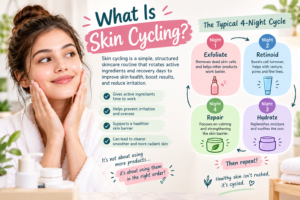
The basic idea is simple: rather than applying exfoliating acids, retinoids, and other powerful treatments on consecutive nights, you give your skin planned recovery periods.
A traditional four-night skin cycling schedule looks like this:
- Night 1: Exfoliation
- Night 2: Retinoid
- Night 3: Recovery
- Night 4: Recovery
- Repeat the cycle
The exact schedule doesn’t need to be identical for everyone. Your skin type, tolerance, products, and goals should determine how often you use active ingredients.
Why Has Skin Cycling Become Popular?
Many people use several active skincare ingredients at once. While ingredients such as retinoids and exfoliating acids can be useful, using too many irritating products too frequently may cause dryness, redness, burning, peeling, or sensitivity.
Skin cycling offers a simpler approach: use fewer strong actives on the same night and give your skin time to recover between treatments.
How Does Skin Cycling Work?
The basic principle behind skin cycling is alternating treatment nights with recovery nights.
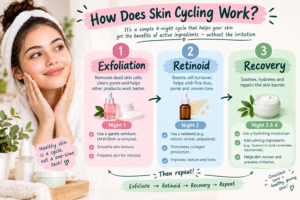
Here’s what a common skin cycling routine looks like.
Night 1: Exfoliation
The first night focuses on exfoliation.
An exfoliating product may contain ingredients such as:
- Alpha hydroxy acids (AHAs)
- Beta hydroxy acids (BHAs)
- Polyhydroxy acids (PHAs)
These ingredients help loosen and remove dead skin cells from the skin’s surface.
After cleansing, apply your exfoliating product according to its instructions. Follow with a moisturizer that supports comfortable, hydrated skin.
You generally don’t need to combine exfoliation with a retinoid on the same night, especially if you’re new to active ingredients.
Night 2: Retinoid
The second night focuses on a retinoid, such as retinol.
Retinoids can support skin cell turnover and are commonly used to address concerns such as fine lines, uneven texture, and acne.
A simple routine might be:
Cleanser → retinoid → moisturizer
If your skin is sensitive, you may benefit from applying moisturizer before and after retinoid use. This is sometimes called the “sandwich” method.
Nights 3 and 4: Recovery
The final two nights are recovery nights.
Instead of using exfoliating acids or retinoids, focus on gentle cleansing and moisturizing.
A recovery routine might look like:
Gentle cleanser → hydrating serum if needed → moisturizer
Ingredients commonly used to support hydration include:
- Ceramides
- Glycerin
- Hyaluronic acid
- Squalane
- Panthenol
The goal isn’t to add more treatments. It’s to keep the routine simple and comfortable.
Skin Cycling Routine Step by Step
If you’re trying skin cycling for beginners, start with a simple routine rather than adding several active ingredients immediately.
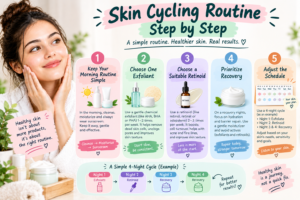
Step 1: Keep Your Morning Routine Simple
Skin cycling is primarily a nighttime strategy, but your morning routine still matters.
A basic morning routine can include:
- Gentle cleanser, if needed
- Moisturizer
- Broad-spectrum sunscreen
Daily sunscreen is particularly important when you’re using exfoliating acids or retinoids because these products can make skin more vulnerable to irritation from sunlight.
Step 2: Choose One Exfoliant
Don’t use several exfoliating products simply because they’re available.
Choose one suitable exfoliant and introduce it gradually.
For example, you might use a mild AHA or BHA once a week initially and increase frequency only if your skin tolerates it well.
Step 3: Choose a Suitable Retinoid
If retinoids are appropriate for your skin concerns, start with a beginner-friendly option and use a small amount.
Retinoids can cause dryness and irritation when introduced too quickly, so there’s no advantage to rushing.
Step 4: Prioritize Recovery
Recovery nights are an important part of the skin cycling routine.
Avoid turning recovery nights into another opportunity to use acids, scrubs, retinoids, or several treatment serums.
Think hydration and comfort, not maximum activity.
Step 5: Adjust the Schedule
The four-night schedule is only a starting point.
If your skin becomes dry, irritated, or uncomfortable, reduce the frequency of active nights and add more recovery nights.
If your skin handles the routine well, you may eventually adjust the schedule based on your individual needs.
Skin Cycling Benefits
Skin cycling can be useful because it encourages a more controlled approach to active skincare.

Potential benefits include:
1. It Can Reduce Overuse of Actives
Using several strong ingredients together can make it difficult to identify what’s causing irritation.
Spacing active ingredients apart can make a routine easier to manage.
2. It Simplifies Your Routine
Instead of wondering whether you should use every serum every night, skin cycling gives each active ingredient a specific place in your routine.
3. It May Help Reduce Irritation
Recovery nights can give irritated or dry skin more time to settle.
However, skin cycling isn’t a guarantee against irritation. Even one active ingredient can cause problems if it’s too strong or used too often.
4. It Makes Active Ingredients Easier to Introduce
Beginners may find a structured schedule easier to follow than using multiple products without a clear plan.
5. It Encourages Attention to Your Skin
A good routine isn’t simply about following a calendar. You should watch how your skin responds and adjust accordingly.
Does Skin Cycling Really Work?
Skin cycling can work as a practical way to organize active skincare, but the schedule itself isn’t a scientifically proven treatment that everyone needs. The benefits mainly come from using established ingredients appropriately and avoiding unnecessary irritation. Exfoliants and retinoids can provide skincare benefits, but you don’t have to follow a four-night cycle to benefit from them.
This distinction is important.
Skin cycling is better understood as a routine strategy rather than a special skincare treatment.
For example, if retinol works well for you when used twice a week, you don’t necessarily need to follow a strict four-night cycle. Likewise, someone with sensitive skin may need considerably more recovery time.
The best schedule is the one your skin can tolerate consistently.
Skin Cycling for Beginners
If you’re completely new to active skincare, don’t start by using strong exfoliation and retinoids frequently.
A gentler approach may look like this:
Week 1–2
- One exfoliation night
- One retinoid night, if appropriate
- Several recovery nights
Then monitor your skin.
If you experience persistent burning, significant peeling, swelling, or worsening irritation, stop the irritating product and allow your skin to recover.
Once your skin is comfortable, you can gradually determine whether you need more frequent active nights.
Skin Cycling for Sensitive Skin
Skin cycling for sensitive skin often requires a slower schedule.
Sensitive skin may react more easily to:
- Strong exfoliating acids
- Retinoids
- Fragranced products
- Physical scrubs
- High concentrations of active ingredients
You may need more recovery nights than the traditional schedule suggests.
A gentler cycle could involve:
Exfoliation → Recovery → Retinoid → Recovery → Recovery
You could also skip exfoliation temporarily if your skin is already irritated.
If your skin frequently becomes red, itchy, painful, or inflamed, it’s worth discussing your routine with a dermatologist rather than continuing to experiment with multiple active ingredients.
Skin Cycling for Acne-Prone Skin
Skin cycling for acne-prone skin can be useful when the goal is to introduce acne-targeting ingredients without overwhelming the skin.
Retinoids and salicylic acid are commonly used in acne care, but acne treatment should be individualized.
If you’re using prescription acne medication, don’t automatically add a skin cycling schedule on top of your treatment. Some medications already contain active ingredients, and combining treatments can increase irritation.
For acne-prone skin, focus on:
- Gentle cleansing
- Appropriate acne treatment
- Non-comedogenic moisturizer
- Daily sunscreen
- Avoiding aggressive scrubbing
- Introducing new products gradually
If you have moderate or severe acne, painful cysts, scarring, or persistent breakouts, professional medical advice is more appropriate than relying solely on a skincare routine.
Skin Cycling With Retinol
Skin cycling with retinol can be helpful for people who are still getting used to retinoids.
Retinol may cause dryness, peeling, redness, or irritation, particularly during the adjustment period.
To make the introduction gentler:
- Start with a low frequency.
- Use a small amount.
- Apply it to dry skin unless product instructions say otherwise.
- Follow with moisturizer.
- Avoid combining it with strong exfoliating products on the same night.
- Increase frequency gradually if your skin tolerates it.
Remember that stronger or more frequent use isn’t automatically better.
Skin Cycling and Exfoliation
Skin cycling exfoliation usually happens on the first night of the cycle.
Chemical exfoliants can improve the appearance of rough or uneven skin by helping remove dead cells from the skin’s surface.
But exfoliation is easy to overdo.
Signs that you may be exfoliating too much include:
- Persistent redness
- Burning or stinging
- Tightness
- Excessive dryness
- Peeling
- Increased sensitivity
- Skin that feels uncomfortable after applying basic products
If these symptoms occur, pause exfoliation and simplify your routine.
A Simple Skin Cycling Schedule
Here’s an example of a beginner-friendly schedule:
| Night | Routine | Main Goal |
|---|---|---|
| Night 1 | Cleanser → exfoliant → moisturizer | Exfoliation |
| Night 2 | Cleanser → retinoid → moisturizer | Retinoid treatment |
| Night 3 | Cleanser → moisturizer | Recovery |
| Night 4 | Cleanser → moisturizer | Recovery |
Then repeat only if your skin remains comfortable.
This isn’t a rule that every person should follow. Some people may need one active night followed by several recovery nights.
Who Should Avoid Skin Cycling?
Skin cycling isn’t automatically appropriate for everyone.
You may need extra caution if you have:
- Very sensitive or reactive skin
- A severely irritated skin barrier
- Eczema or another inflammatory skin condition
- Rosacea
- Active dermatitis
- Significant dryness or peeling
People who are pregnant or trying to become pregnant should also discuss retinoid use with their healthcare professional, as topical retinoids are generally avoided during pregnancy.
If you have a diagnosed skin condition, ask a dermatologist before introducing multiple active ingredients.
Common Skin Cycling Mistakes

Using Too Many Actives
Adding vitamin C, exfoliating acids, retinol, benzoyl peroxide, and other treatments without considering their combined effect can increase irritation.
Treating Recovery Nights Like Treatment Nights
A recovery night isn’t the time to add another exfoliating serum because you feel your routine isn’t doing enough.
Keep it simple.
Exfoliating Too Aggressively
More exfoliation doesn’t necessarily mean smoother skin.
Using a strong acid too frequently can damage the skin barrier and make your skin more uncomfortable.
Changing Products Too Often
Give your routine enough time to assess how your skin responds.
Constantly switching products makes it difficult to know what is helping or causing irritation.
Ignoring Your Skin’s Signals
A calendar shouldn’t override your skin.
If your face is burning, peeling heavily, or becoming increasingly red, take a break rather than forcing yourself to complete the cycle.
How to Make Skin Cycling Safer
A few habits can make a skin cycling routine easier to tolerate:
- Introduce one active ingredient at a time.
- Patch test new products when appropriate.
- Use moisturizer consistently.
- Avoid harsh physical scrubs.
- Wear sunscreen during the day.
- Don’t increase active frequency too quickly.
- Give irritated skin time to recover.
- Follow the instructions for prescription products.
- Don’t assume stronger products are automatically better.
Can You Use Vitamin C During Skin Cycling?
Yes, vitamin C can often fit into a skin cycling routine, particularly in the morning.
For example:
Morning: Cleanser → vitamin C → moisturizer → sunscreen
Night: Follow your skin cycling schedule.
However, vitamin C isn’t necessary for everyone. If your routine is already irritating your skin, simplifying it may be more useful than adding another active ingredient.
Can You Use Niacinamide During Skin Cycling?
Niacinamide is generally considered a relatively well-tolerated skincare ingredient and can often be used during both active and recovery routines.
However, more isn’t always better.
If your skin is sensitive, start with a simple formula and avoid layering numerous products just because they’re marketed for different concerns.
How Long Does Skin Cycling Take to Show Results?
There’s no universal timeline because results depend on the active ingredients you’re using, your skin concerns, product strength, and how consistently you use them.
Hydration and comfort may improve relatively quickly when you simplify an irritated routine.
Concerns such as acne, uneven texture, pigmentation, and signs of aging generally require more time and consistent care.
The important point is that skin cycling itself isn’t what produces all of these results. The individual skincare ingredients and consistent routine are responsible for most of the treatment effects.
Key Takeaways
- Skin cycling is a way to organize active skincare products.
- A traditional schedule uses exfoliation, retinoid, and recovery nights.
- The four-night cycle isn’t a requirement for healthy skin.
- Beginners should introduce active ingredients slowly.
- Sensitive skin may need more recovery nights.
- Avoid combining multiple irritating actives without a good reason.
- Moisturizer and sunscreen remain important.
- Skin cycling can help simplify a complicated routine.
- Stop or reduce irritating products if your skin becomes uncomfortable.
- Individual skin needs matter more than following a strict calendar.
Frequently Asked Questions
1. What is skin cycling?
Skin cycling is a skincare routine that alternates active ingredients, such as exfoliants and retinoids, with recovery nights. The common approach uses exfoliation on night one, retinoid on night two, and moisturizing-only recovery nights afterward.
2. Does skin cycling really work?
Skin cycling can be a useful way to organize active ingredients and reduce unnecessary irritation. However, the cycle itself isn’t a special treatment. The benefits mainly come from using proven skincare ingredients appropriately and maintaining a consistent routine.
3. Is skin cycling good for beginners?
Yes, it can be helpful for beginners because it provides a simple structure for introducing active ingredients. Beginners should start slowly and adjust the frequency based on their skin’s response.
4. Can I do skin cycling every week?
You can repeat a skin cycling schedule if your skin tolerates it. However, you don’t need to follow the same schedule every week. Dry, sensitive, or irritated skin may need additional recovery days.
5. Can I use retinol and exfoliating acids together?
It’s usually better to avoid using potentially irritating exfoliating acids and retinoids on the same night, particularly if you’re new to either ingredient. Separating them can make irritation easier to manage.
6. Is skin cycling good for sensitive skin?
It can be adapted for sensitive skin, but sensitive skin may require fewer active nights and more recovery days. If your skin is already irritated, focus on gentle cleansing and moisturizing until it settles.
7. Can I use vitamin C while skin cycling?
Vitamin C can often be used in a morning routine while skin cycling at night. However, if your skin is sensitive or irritated, keep your routine simple and introduce products gradually.
8. How often should beginners exfoliate during skin cycling?
There’s no single frequency that works for everyone. Beginners can start with less frequent exfoliation and increase only if their skin remains comfortable. Stronger exfoliants may require even less frequent use.
9. Can skin cycling help acne-prone skin?
It may help organize acne-focused ingredients and reduce unnecessary irritation. However, persistent or moderate-to-severe acne may require professional treatment rather than relying on a skincare schedule alone.
10. What should I do if skin cycling irritates my skin?
Stop or reduce the products causing irritation and return to a gentle routine with cleanser, moisturizer, and sunscreen. If irritation is severe, persistent, painful, or associated with swelling, seek medical advice.
Final Thoughts
Skin cycling is best viewed as a simple framework for managing active skincare ingredients, not a mandatory four-night formula. It can be especially useful if you’re new to retinoids or exfoliating acids and tend to use too many products at once.
The most effective routine is one your skin can tolerate consistently. Start slowly, protect your skin barrier, use sunscreen during the day, and adjust the schedule when your skin tells you it needs more recovery.