
The “Moisture Sandwich” skincare method is a simple layering technique designed to help keep water in the skin and make a hydrating routine feel more comfortable. It generally involves applying hydrating products to slightly damp skin and following them with a moisturizer or occlusive layer. The method can be especially useful for dry or dehydrated skin, although it isn’t necessary for everyone.
If your skin often feels tight after cleansing, looks flaky, or seems dry even after applying moisturizer, you’ve probably wondered whether you’re missing something in your routine. The answer isn’t always another product.
Sometimes, how you layer your skincare matters just as much as what you use.
That’s where the moisture sandwich technique comes in.
What Is the “Moisture Sandwich” Skincare Method?
The moisture sandwich skincare method is a layering technique that uses hydration-focused products on damp skin and then seals that hydration with a moisturizer or another suitable occlusive layer.
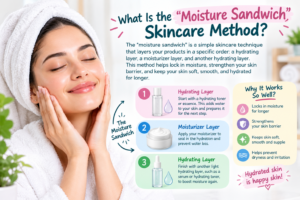
The basic idea is simple:
Damp skin → hydrating product → moisturizer → optional occlusive
The term “moisture sandwich” isn’t a standardized dermatological treatment. It’s a skincare term used online to describe a way of layering products to support skin hydration.
The reasoning behind the technique is consistent with established moisturizer science. Moisturizers commonly use humectants, emollients, and occlusives to improve hydration and reduce water loss from the outer layer of the skin.
The technique can therefore be thought of as a practical way of combining these hydration principles rather than as a special treatment in itself.
How Does the Moisture Sandwich Technique Work?
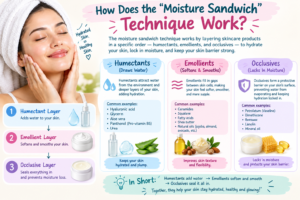
To understand the method, it helps to understand what different moisturizing ingredients actually do.
Humectants
Humectants attract and hold water in the outermost layer of the skin.
Common examples include:
- Glycerin
- Hyaluronic acid
- Urea
- Sorbitol
- Panthenol
Humectants are commonly used in moisturizers and hydrating serums because they help increase the water content of the stratum corneum, the outermost layer of the epidermis.
Emollients
Emollients help soften and smooth the skin by filling gaps between skin cells and improving the feel of the skin.
Examples can include certain:
- Plant oils
- Fatty alcohols
- Lipids
- Silicones
- Other skin-softening ingredients
Occlusives
Occlusives form a protective layer over the skin that slows water evaporation.
Common examples include:
- Petrolatum
- Mineral oil
- Dimethicone
- Paraffin
Occlusives can be particularly useful when the skin is very dry because they help reduce transepidermal water loss.
Why the combination matters
A moisturizer may contain more than one type of ingredient. In fact, many modern moisturizers combine humectants, emollients, and occlusives.
That means you don’t necessarily need three separate products to perform a moisture sandwich. A well-formulated moisturizer may already provide several of these functions.
What Does “Moisture Sandwich” Actually Mean?
The name sounds complicated, but the method isn’t.
Think of your skin as the filling and the hydrating layers as the bread around it.
A basic routine might look like this: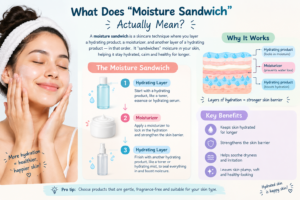
- Cleanse gently.
- Leave the skin slightly damp.
- Apply a hydrating serum or essence.
- Apply moisturizer.
- Add a thin occlusive layer if your skin needs extra protection.
The final occlusive layer is optional, not a required part of every routine.
For some people, moisturizer alone is enough.
How to Do a Moisture Sandwich Step by Step
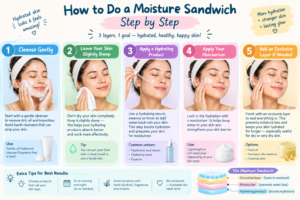
Step 1: Cleanse gently
Start with a gentle cleanser if you need to wash your face.
Avoid using very hot water or cleansing aggressively, especially if your skin already feels dry or sensitive.
After cleansing, don’t completely dry your face.
Step 2: Leave your skin slightly damp
This is one of the most useful parts of the technique.
Your skin should be slightly damp, not dripping wet.
Applying moisturizer to damp skin can help trap water before it evaporates. Dermatologists commonly recommend applying moisturizer soon after bathing or washing while the skin is still damp.
Step 3: Apply a hydrating product
If you use a hydrating serum, essence, or toner, apply a thin layer while your skin is still slightly damp.
Look for ingredients such as:
- Glycerin
- Hyaluronic acid
- Panthenol
- Urea
- Other suitable humectants
You don’t need several hydrating products.
One well-tolerated product can be enough.
Step 4: Apply your moisturizer
Follow the hydrating layer with a moisturizer.
Choose the texture according to your skin.
Dry skin:
A richer cream may feel more comfortable.
Combination skin:
Use more moisturizer on dry areas and less on oily areas.
Oily skin:
A lightweight gel-cream or lotion may be sufficient.
Sensitive skin:
A simple, fragrance-free moisturizer may be easier to tolerate.
The American Academy of Dermatology notes that moisturizer isn’t one-size-fits-all and that creams and ointments can be more useful for very dry skin than lighter lotions.
Step 5: Add an occlusive layer if needed
If your skin remains very dry, you can finish with a very thin layer of an occlusive product.
Petrolatum is a common example.
This step can help reduce water loss from the skin surface, but it isn’t necessary for everyone.
If you have oily or acne-prone skin and dislike heavy textures, you may prefer to stop after moisturizer.
A Simple Moisture Sandwich Routine
Here’s an easy example for someone with dry skin: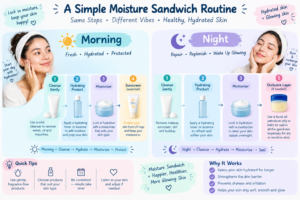
Morning
- Gentle cleanser or rinse
- Hydrating serum
- Moisturizer
- Broad-spectrum sunscreen
Night
- Gentle cleanser
- Hydrating serum
- Moisturizer
- Optional thin occlusive layer
The goal isn’t to create as many layers as possible.
The goal is to support hydration without irritating the skin.
Moisture Sandwich for Dry Skin
A moisture sandwich can be particularly appealing if you have dry skin because dry skin often has difficulty retaining water.
Dry skin can be associated with increased water loss from the outer skin layer. Environmental factors such as low humidity, cold weather, wind, harsh cleansing, and frequent washing can make dryness worse.
For dry skin, focus on:
- Gentle cleansing
- Damp-skin application
- Humectants
- Rich moisturizers
- Emollients
- Occlusives when necessary
- Consistent sunscreen during the day
You don’t need to use every category separately.
A single moisturizer may already combine several of them.
Moisture Sandwich for Sensitive Skin
The method can also be adapted for sensitive skin, but simpler is usually better.
Sensitive skin may react to fragrances, strong acids, essential oils, or other ingredients depending on the individual.
A basic approach is:
Gentle cleanser → damp skin → simple moisturizer → optional occlusive
If you want to use a hydrating serum, introduce it separately rather than adding several new products at once.
For sensitive skin, consider:
- Fragrance-free products
- Fewer ingredients when possible
- Gentle cleansing
- Avoiding unnecessary exfoliation
- Patch testing new products
- Introducing one new product at a time
If a product burns, stings persistently, or causes a rash, stop using it rather than trying to “push through” the reaction.
Is the Moisture Sandwich Good for Dehydrated Skin?
It can be useful, but it’s important to understand what dehydrated skin means.
Dehydrated skin lacks water, whereas dry skin generally refers to skin that lacks sufficient lipids or oil and has impaired moisture retention.
A person can have oily skin and still experience dehydration.
That’s why adding a lightweight hydrating product under a moisturizer can sometimes make sense even for people who don’t have traditionally dry skin.
However, more layers don’t automatically mean more hydration.
If your skin already feels comfortable with a simple moisturizer, you may not need a more complicated routine.
Moisture Sandwich vs. Regular Moisturizing
What’s the difference?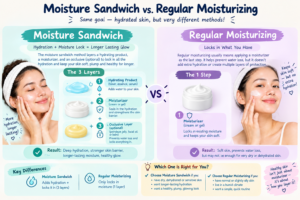
Regular moisturizing
You might simply:
Cleanse → moisturize → sunscreen
or at night:
Cleanse → moisturize
Moisture sandwich
You might use:
Cleanse → damp skin → hydrating layer → moisturizer → optional occlusive
The moisture sandwich therefore adds a hydration-focused layering strategy.
But it isn’t necessarily more effective for everyone.
Many moisturizers already contain humectants, emollients, and occlusives, so a single product may provide several benefits at once.
Benefits of the Moisture Sandwich Method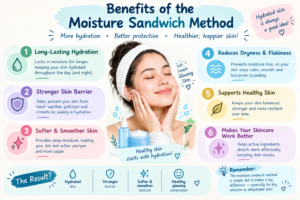
1. Helps support skin hydration
Applying hydrating products and moisturizer to damp skin can help support water retention in the outer skin layer.
Moisturizers are designed to increase hydration and reduce water loss through different mechanisms.
2. Can make dry skin feel more comfortable
Dry skin may feel tight, rough, flaky, or uncomfortable.
A consistent moisturizing routine can improve the feel and appearance of dry skin.
3. Helps reduce water loss
Occlusive ingredients such as petrolatum and dimethicone can reduce water loss by forming a protective layer on the skin.
4. Can simplify hydration layering
Instead of adding several active ingredients, the technique focuses on a basic goal: hydration and moisture retention.
5. Can be adjusted for different skin types
You don’t have to follow one rigid version.
You can make the routine lighter or richer depending on your skin’s needs.
Are There Any Downsides?
Yes.
The moisture sandwich isn’t automatically better simply because it contains more layers.
It may feel too heavy
Multiple moisturizing layers can feel greasy or uncomfortable, especially for people with oily skin.
It may cause pilling
Applying several products one after another can sometimes cause products to ball up or pill.
If this happens, reduce the number of layers or allow products to settle before applying the next one.
More products can mean more irritation
Every additional product introduces another set of ingredients.
For sensitive skin, this can make it harder to identify what’s causing irritation.
Occlusives aren’t always necessary
A heavy occlusive layer can feel uncomfortable and may not be appropriate for every person or every part of the face.
It doesn’t replace treatment for skin disease
Persistent dryness, redness, itching, cracking, or scaling may have an underlying cause that requires professional evaluation.
Common Moisture Sandwich Mistakes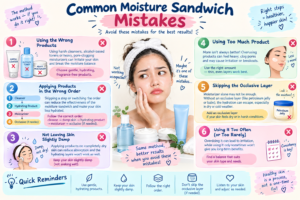
Mistake 1: Applying products to soaking-wet skin
Your face doesn’t need to be dripping wet.
Slightly damp skin is enough.
Mistake 2: Using too many products
A five-step hydration routine isn’t automatically better than a two-step routine.
Start simple.
Mistake 3: Using strong actives at the same time
If your skin is irritated or very dry, adding several exfoliating acids or retinoids may make the problem worse.
Focus on restoring comfort first.
Mistake 4: Using a heavy occlusive everywhere
An occlusive can be useful for dry areas, but you don’t necessarily need a thick layer across your entire face.
Mistake 5: Ignoring sunscreen
Hydration is only one part of daytime skincare.
Sunscreen remains important for protecting skin from UV radiation.
Mistake 6: Changing everything at once
If you introduce a cleanser, serum, moisturizer, and occlusive simultaneously, you won’t know which product is helping or irritating your skin.
How Often Should You Do a Moisture Sandwich?
There’s no universal requirement to perform the technique every day.
You can use it:
- Every night if your skin tolerates it
- During dry weather
- When indoor heating or air conditioning makes your skin feel dry
- On particularly dry areas
- Whenever your normal moisturizer doesn’t feel sufficient
If your skin is comfortable with a basic moisturizing routine, there’s no need to add extra layers simply because the technique is trending.
A consistent routine that your skin tolerates is more useful than an elaborate routine you can’t maintain.
Can Oily Skin Use the Moisture Sandwich?
Yes, but the routine should be lighter.
Oily skin still needs hydration.
Instead of layering a thick serum, rich cream, and petrolatum, you might use:
Damp skin → lightweight hydrating product → lightweight moisturizer
You may not need an occlusive layer at all.
You can also apply more moisturizer to dry areas and less to areas that already feel oily.
Can You Use Hyaluronic Acid in a Moisture Sandwich?
Yes.
Hyaluronic acid is a humectant commonly used in hydrating skincare products. Humectants help attract and retain water in the outer skin layer.
If you use a hyaluronic-acid product, applying it according to the product’s directions and following it with a moisturizer can be a practical approach.
The important point is that hyaluronic acid doesn’t need to be treated as a magical hydration step.
Your moisturizer may already contain humectants.
What Ingredients Work Well in a Moisture Sandwich?
Look for ingredients based on what your skin needs.
| Ingredient type | Examples | Main role |
|---|---|---|
| Humectants | Glycerin, hyaluronic acid, urea | Attract and hold water |
| Emollients | Certain oils, fatty alcohols, lipids | Soften and smooth skin |
| Occlusives | Petrolatum, dimethicone, mineral oil | Reduce water loss |
| Barrier-supporting ingredients | Ceramides and lipids | Support the skin barrier |
A product doesn’t have to contain every ingredient listed above.
Many moisturizers combine multiple types of moisturizing ingredients.
Moisture Sandwich vs. Slugging
These techniques are related but aren’t identical.
Moisture sandwiching focuses on layering hydration and moisturizer, often starting on damp skin.
Slugging generally refers to applying a petrolatum-based occlusive layer as the final step of a routine to reduce water loss.
You can use an occlusive as the final step of a moisture sandwich, but you don’t have to.
Think of slugging as one possible finishing strategy rather than the definition of the entire moisture sandwich method.
Expert Tips for Better Skin Hydration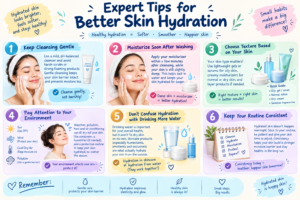
Keep cleansing gentle
Harsh cleansing can contribute to dryness and discomfort. A gentle cleanser may be enough for many people.
Moisturize soon after washing
Applying moisturizer while skin is still damp can help trap water and reduce evaporation. This is also recommended by dermatology guidance for dry skin.
Choose texture based on your skin
Don’t automatically choose the thickest product.
Your ideal moisturizer is one that provides enough comfort and hydration without causing problems.
Pay attention to your environment
Cold, dry air, wind, frequent washing, and indoor heating or air conditioning can affect how dry your skin feels.
Don’t confuse hydration with drinking more water
Drinking enough fluids is important for general health, but simply drinking extra water isn’t a substitute for topical moisturization when the skin barrier is dry.
Keep your routine consistent
Skin hydration usually benefits more from regular, appropriate moisturization than from occasionally applying many products.
When Should You Avoid Experimenting With the Method?
Be cautious if your skin is:
- Cracked
- Bleeding
- Severely inflamed
- Burning
- Developing a new rash
- Extremely itchy
- Reacting to multiple skincare products
Very dry or irritated skin can sometimes be associated with conditions such as eczema, contact dermatitis, psoriasis, or other disorders.
If dryness is persistent or severe, a dermatologist can help determine the underlying cause instead of relying only on cosmetic layering.
Frequently Asked Questions
1. What is the moisture sandwich skincare method?
The moisture sandwich skincare method is a skincare layering approach that typically involves applying hydrating products to slightly damp skin, followed by moisturizer and sometimes an occlusive layer. Its purpose is to support hydration and reduce water loss.
2. How do you do a moisture sandwich?
Start with clean, slightly damp skin. Apply a hydrating product if needed, follow with moisturizer, and optionally apply a thin occlusive layer. During the day, finish with sunscreen.
3. Is the moisture sandwich good for dry skin?
It can be useful for dry skin because applying moisturizer to damp skin helps trap water, while moisturizing ingredients and occlusives can support hydration and reduce water loss.
4. Can I use the moisture sandwich if I have oily skin?
Yes. Use lightweight hydrating products and moisturizer, and skip a heavy occlusive if your skin doesn’t need it.
5. Is the moisture sandwich the same as slugging?
No. Slugging usually involves applying a petrolatum-based occlusive as the final step. The moisture sandwich is a broader hydration-layering technique.
6. Do I need a hydrating serum?
No. A hydrating serum is optional. Many moisturizers already contain humectants and other moisturizing ingredients.
7. Can sensitive skin use the moisture sandwich?
Yes, but keep the routine simple. Fragrance-free, gentle products are often preferable for sensitive or easily irritated skin. Introduce new products one at a time.
8. Should my face be completely wet?
No. Slightly damp skin is enough. Excess water isn’t necessary for the technique.
9. Can the moisture sandwich cause breakouts?
It can feel too heavy for some people, especially when several rich products or occlusives are layered. If you notice congestion or breakouts, simplify the routine and use lighter textures.
10. How often should I use the moisture sandwich?
There is no fixed schedule. You can use a simplified version daily if your skin tolerates it, or use it when your skin feels particularly dry. A basic moisturizer may be all you need.
Key Takeaways
- The moisture sandwich skincare method is a hydration-focused layering technique.
- It commonly involves slightly damp skin → hydrating product → moisturizer → optional occlusive.
- Damp-skin moisturization is supported by established dermatology guidance for managing dry skin.
- Humectants help attract and retain water.
- Emollients help soften and smooth the skin.
- Occlusives help reduce water loss.
- You don’t need multiple products to benefit from these mechanisms.
- Dry and dehydrated skin may benefit from a more hydration-focused routine.
- Oily skin can use a lighter version.
- Sensitive skin generally benefits from keeping the routine simple and avoiding unnecessary irritants.
- More skincare layers aren’t automatically better.
- Persistent or severe dryness may require professional evaluation.
Final Thoughts
The “Moisture Sandwich” skincare method isn’t a complicated treatment or a requirement for healthy skin. It’s simply a useful way to think about hydration: add water-friendly ingredients when appropriate, moisturize damp skin, and use an occlusive layer when your skin needs extra help holding onto moisture.
For many people, the most effective version may be surprisingly simple. A gentle cleanser, a suitable moisturizer, and consistent sunscreen can provide a strong foundation. If your skin remains dry, adding a hydrating layer or a suitable occlusive may make the routine more comfortable.
The best skincare layering technique is ultimately the one that supports your skin without overwhelming it.