
Natural beauty products have become increasingly popular among people who want simpler skincare, hair care, and personal care routines. These products often contain ingredients derived from plants, minerals, or other naturally sourced materials. However, “natural” doesn’t automatically mean safer, gentler, or more effective for everyone.
The benefits of natural beauty products can include exposure to plant-derived ingredients, simpler formulations, and useful moisturizing or soothing properties. Their limitations include possible allergies, irritation, inconsistent definitions of “natural,” shorter shelf life for some formulations, and limited evidence for certain beauty claims. The best choice depends on the ingredients, formulation, your skin or hair needs, and how your body responds.
What Are Natural Beauty Products?
Natural beauty products are skincare, hair care, body care, or cosmetic products that contain ingredients obtained wholly or partly from natural sources. These may include plants, fruits, seeds, flowers, minerals, clays, and naturally derived oils or extracts.
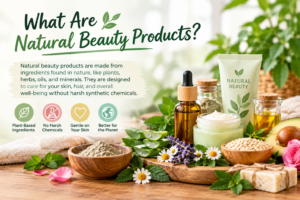
Examples include:
- Plant oils such as jojoba, coconut, sunflower, and argan oil
- Botanical extracts such as aloe vera, chamomile, and green tea
- Natural butters such as shea butter and cocoa butter
- Clays such as kaolin and bentonite
- Plant-derived ingredients used for cleansing, moisturizing, or conditioning
However, there isn’t one universal definition of “natural beauty product.” A product marketed as natural can contain a mixture of naturally sourced, naturally derived, and synthetic ingredients.
That’s why reading the ingredient list is often more useful than relying on the word “natural” on the label.
What Makes a Beauty Product “Natural”?
The term natural can mean different things depending on the brand, certification system, and country. Some products contain mostly naturally sourced ingredients, while others may use a small amount of botanical ingredients alongside conventional cosmetic ingredients.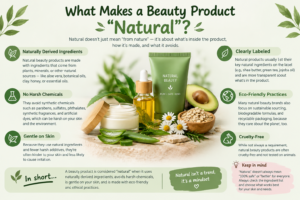
This distinction matters because a product can be natural without being organic, and organic without necessarily being completely natural.
Natural vs. Organic Beauty Products
Natural beauty products generally emphasize ingredients obtained from natural sources.
Organic beauty products usually refer to ingredients produced according to specific organic farming standards. Depending on the certification, these standards may address farming practices, processing, and permitted substances.
The terms aren’t interchangeable.
A product containing organic plant extracts may still contain other non-organic ingredients. Likewise, a naturally sourced ingredient isn’t necessarily certified organic.
Benefits of Natural Beauty Products
Natural beauty products can offer several useful qualities, particularly when they’re well formulated and suited to your individual needs.
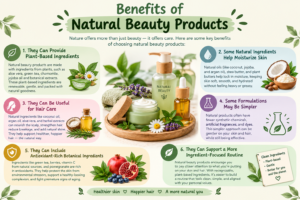
1. They Can Provide Plant-Based Ingredients
Many natural skincare products contain botanical ingredients that have useful cosmetic properties.
For example:
- Aloe vera can provide a soothing and hydrating feel.
- Jojoba oil can help soften and condition the skin.
- Shea butter can help reduce dryness by supporting the skin’s moisture barrier.
- Green tea extracts contain antioxidant compounds.
- Oat-based ingredients can help soothe dry or sensitive-feeling skin.
The benefit comes from the specific ingredient and its formulation—not simply from the fact that a product is labeled natural.
2. Some Natural Ingredients Help Moisturize Skin
Plant oils and natural butters are common in moisturizers because they can soften the skin and reduce moisture loss.
Ingredients such as shea butter, sunflower oil, jojoba oil, and squalane can be useful in products designed for dry skin.
However, natural oils aren’t suitable for every person. Someone with oily or acne-prone skin may prefer a lightweight, non-comedogenic moisturizer rather than a rich oil-based product.
3. They Can Be Useful for Hair Care
Natural beauty products for hair often contain oils, botanical extracts, butters, and plant proteins.
Depending on the formulation, these ingredients may help:
- Reduce the feeling of dryness
- Improve softness
- Add shine
- Condition the hair
- Reduce friction during grooming
- Make dry or coarse hair feel smoother
For example, coconut oil can reduce protein loss from hair when used appropriately, while lightweight oils can help improve the feel and appearance of dry strands.
Natural hair care, however, shouldn’t be confused with guaranteed hair growth. An oil or botanical ingredient can’t automatically treat every cause of hair loss.
4. Some Formulations May Be Simpler
Some natural beauty products are designed around a relatively short ingredient list.
A simpler formula can make it easier to identify individual ingredients if you’re trying to avoid a particular substance.
But “fewer ingredients” doesn’t necessarily mean “better.” A well-designed conventional formula can also be gentle and effective.
5. They Can Include Antioxidant-Rich Botanical Ingredients
Plants contain various compounds that can have antioxidant activity. Beauty formulations may use extracts from ingredients such as green tea, rosemary, grape seed, or certain fruits and herbs.
Antioxidants can help protect cosmetic formulations and may provide benefits to the skin when used in appropriately formulated products.
Still, antioxidant activity in a laboratory isn’t the same thing as a proven clinical effect on human skin. The concentration, stability, delivery system, and overall formulation all matter.
6. They Can Support a More Ingredient-Focused Routine
Choosing natural beauty products can encourage people to pay closer attention to what they’re applying to their skin and hair.
Instead of choosing a product based only on marketing claims, you may start looking at:
- Active ingredients
- Fragrance
- Preservatives
- Potential allergens
- Product purpose
- Skin compatibility
- Evidence behind specific claims
That habit can be more valuable than simply choosing products labeled “natural.”
Limitations of Natural Beauty Products
Natural ingredients can be useful, but they aren’t automatically superior to synthetic ingredients. There are several limitations worth understanding.
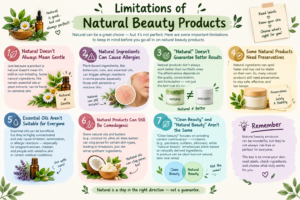
1. Natural Doesn’t Always Mean Gentle
This is one of the most important points.
Some natural ingredients can irritate the skin or trigger allergic reactions. Essential oils, botanical extracts, and fragrant plant compounds may be particularly problematic for people with sensitive skin.
For example, essential oils can cause irritation or allergic contact dermatitis in some individuals.
If your skin is sensitive, introducing several natural products at once can make it difficult to identify what caused a reaction.
2. Natural Ingredients Can Cause Allergies
Plants contain many biologically active compounds, and some can trigger allergies.
Commonly used botanical ingredients may be perfectly comfortable for one person and irritating for another.
If you know you’re allergic to a particular plant, seed, nut, or fragrance component, check the ingredient list carefully.
A patch test can also be useful when introducing a new topical product, although it cannot guarantee that a reaction won’t occur.
3. “Natural” Doesn’t Guarantee Better Results
A natural ingredient can have an impressive reputation without having strong evidence for every beauty claim associated with it.
For example, an ingredient may have moisturizing or conditioning properties but have little evidence that it can significantly stimulate hair growth or remove wrinkles.
It’s better to judge a product by its specific ingredients, concentration, formulation, and evidence rather than by its marketing category.
4. Some Natural Products Need Preservatives
Water-based skincare products can support microbial growth if they’re not properly preserved.
This means a safe cosmetic formula may need an effective preservative system, whether its ingredients are natural, synthetic, or a combination of both.
Avoid assuming that a preservative-free product is automatically safer.
Poorly preserved water-based products can become contaminated and may pose a greater risk than a properly preserved formula.
5. Essential Oils Aren’t Suitable for Everyone
Essential oils are concentrated plant extracts frequently used in natural skincare and hair care.
Although some have useful cosmetic properties, they can also cause irritation, sensitization, or allergic reactions.
Applying undiluted essential oils directly to the skin is particularly risky.
People with sensitive or reactive skin may prefer fragrance-free products instead.
6. Natural Products Can Still Be Comedogenic
Some oils and butters may contribute to clogged pores for certain people.
This doesn’t mean an ingredient is universally “pore-clogging.” Skin response varies, and the overall formulation matters.
If you’re prone to acne, look for products specifically formulated for your skin type rather than assuming that all plant oils will be beneficial.
7. “Clean Beauty” and “Natural Beauty” Aren’t the Same
The terms clean beauty, natural beauty, and organic beauty are often used together, but they don’t necessarily mean the same thing.
Natural beauty generally focuses on naturally sourced ingredients.
Organic beauty focuses on ingredients produced according to organic standards where applicable.
Clean beauty is a broader marketing concept that may emphasize avoiding certain ingredients or following a particular formulation philosophy.
None of these labels alone tells you whether a product will work well for your skin.
Natural Ingredients Commonly Found in Beauty Products
Understanding individual ingredients can help you make more informed choices.
| Natural ingredient | Common cosmetic use |
|---|---|
| Aloe vera | Soothing and hydration |
| Jojoba oil | Skin and hair conditioning |
| Shea butter | Moisturizing and softening |
| Coconut oil | Hair and skin conditioning |
| Oat | Soothing and skin comfort |
| Green tea | Antioxidant-focused formulations |
| Sunflower oil | Emollient and skin conditioning |
| Clay | Cleansing and oil-absorbing products |
| Rose water | Fragrance and refreshing skin products |
| Argan oil | Hair and skin conditioning |
The presence of an ingredient doesn’t guarantee a particular result. The formula, amount used, stability, and your individual response all matter.
Natural Beauty Products for Skin: How to Choose Them
Choosing natural beauty products for skin should start with your skin’s needs rather than the label.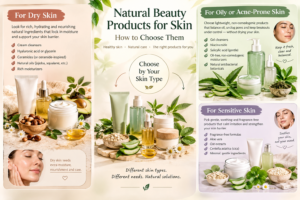
For Dry Skin
Look for ingredients that help soften the skin and reduce moisture loss, such as:
- Shea butter
- Sunflower oil
- Jojoba oil
- Squalane
- Oat-based ingredients
A gentle cleanser and a well-formulated moisturizer are usually more useful than repeatedly applying DIY oils or masks.
For Oily or Acne-Prone Skin
Choose lightweight products and avoid assuming that every natural oil is appropriate.
Look for:
- Lightweight moisturizers
- Non-comedogenic formulations
- Gentle cleansing products
- Products without unnecessary fragrance
Avoid aggressive scrubbing, especially if you’re already experiencing acne or irritation.
For Sensitive Skin
Keep your routine simple.
Consider:
- Fragrance-free products
- Fewer active ingredients
- Gentle cleansers
- Basic moisturizers
- Products with soothing ingredients such as colloidal oatmeal
Be cautious with essential oils and heavily fragranced botanical products.
Natural Beauty Products for Hair
Natural beauty products for hair can be useful for conditioning and improving the feel of the hair.
Common ingredients include:
- Coconut oil
- Argan oil
- Jojoba oil
- Shea butter
- Aloe vera
- Rosemary-derived ingredients
However, hair type matters.
Fine hair may become weighed down by heavy oils and butters, while coarse or very dry hair may tolerate richer conditioning products.
If your main concern is hair loss, don’t rely on natural oils alone. Persistent or sudden hair loss can have many causes and may need professional evaluation.
How to Use Natural Beauty Products Safely
You don’t need a complicated routine to benefit from natural ingredients.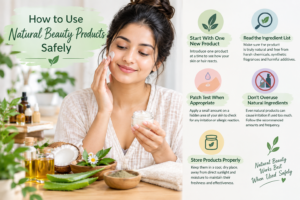
Step 1: Start With One New Product
Introducing several products at once makes it difficult to identify which product is helping or causing irritation.
Step 2: Read the Ingredient List
Don’t rely only on claims such as “natural,” “clean,” or “plant-based.”
Check what the product actually contains.
Step 3: Patch Test When Appropriate
Apply a small amount to a limited area according to the product’s instructions before using it more broadly.
Stop using the product if you develop significant redness, swelling, burning, itching, or other concerning symptoms.
Step 4: Don’t Overuse Natural Ingredients
More isn’t always better.
A concentrated botanical ingredient or essential oil can irritate the skin when used too frequently or at excessive concentrations.
Step 5: Store Products Properly
Follow the storage instructions and pay attention to changes in:
- Smell
- Color
- Texture
- Separation
- Packaging
- Expiration or period-after-opening information
Don’t continue using a product that appears spoiled or contaminated.
Common Mistakes to Avoid
Mistake 1: Assuming Natural Means Safe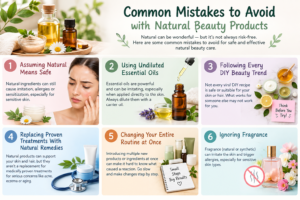
Natural substances can still cause irritation and allergic reactions.
Mistake 2: Using Undiluted Essential Oils
Essential oils are highly concentrated. Applying them directly to the skin can cause irritation or sensitization.
Mistake 3: Following Every DIY Beauty Trend
A kitchen ingredient isn’t automatically appropriate for facial skin.
Some DIY recipes can disrupt the skin barrier or cause irritation.
Mistake 4: Replacing Proven Treatments With Natural Remedies
Natural ingredients can complement a beauty routine, but they shouldn’t automatically replace evidence-based treatment for a diagnosed skin or hair condition.
Mistake 5: Changing Your Entire Routine at Once
Introduce products gradually so you can understand how your skin or hair responds.
Mistake 6: Ignoring Fragrance
“Natural fragrance” can still contain compounds that irritate sensitive skin.
If your skin reacts easily, fragrance-free may be more useful than simply choosing natural fragrance.
Are Natural Beauty Products Better Than Conventional Products?
Not necessarily.
The most appropriate product depends on its formulation and your individual needs. Natural and conventional beauty products can both contain effective and ineffective formulations.
A synthetic ingredient isn’t automatically harmful, just as a natural ingredient isn’t automatically beneficial.
A better approach is to ask:
- What is the product supposed to do?
- Which ingredients provide that function?
- Is there reasonable evidence behind the claim?
- Is the product appropriate for my skin or hair type?
- Does it contain ingredients I know I react to?
- Is the formula properly preserved and packaged?
This approach helps you make decisions based on the product itself rather than the marketing label.
Key Takeaways
- Natural beauty products contain ingredients derived from natural sources, but definitions vary.
- Natural doesn’t automatically mean safer, gentler, or more effective.
- Plant oils, botanical extracts, butters, and clays can have useful cosmetic properties.
- Some natural ingredients can irritate the skin or trigger allergies.
- Essential oils require particular caution because they are highly concentrated.
- Water-based natural products still need appropriate preservation.
- Your skin type, hair type, and individual sensitivities matter.
- Read the complete ingredient list rather than relying only on front-label claims.
- Introduce new products gradually.
- Evidence and formulation matter more than whether a product is labeled natural.
Frequently Asked Questions
Are natural beauty products good for your skin?
They can be. Some natural ingredients provide moisturizing, conditioning, soothing, or antioxidant properties. However, natural products aren’t automatically suitable for everyone. Your skin type, allergies, sensitivities, and the product’s complete formulation all matter.
What are the main benefits of natural beauty products?
Potential benefits include access to plant-derived ingredients, moisturizing oils and butters, botanical antioxidants, and simpler formulations. The actual benefit depends on the specific ingredient and how it’s formulated.
Are natural beauty products safer than conventional products?
Not necessarily. Both natural and synthetic ingredients can be safe or irritating depending on their concentration, formulation, and individual use. “Natural” should not be treated as a guarantee of safety.
Can natural beauty products cause skin irritation?
Yes. Botanical extracts, essential oils, fragrances, and other natural ingredients can cause irritation or allergic reactions in some people. Sensitive skin may require a particularly simple, fragrance-free routine.
Are natural beauty products suitable for sensitive skin?
Some can be, but you need to choose carefully. Fragrance-free, gentle formulations with a limited number of potential irritants may be preferable. Patch testing can help when introducing a new product.
Are natural beauty products good for hair?
Some can help condition and soften hair. Oils such as coconut, jojoba, and argan oil are commonly used for hair conditioning. However, natural hair products aren’t guaranteed to promote hair growth or treat hair loss.
Are organic and natural beauty products the same?
No. “Natural” generally refers to the source of ingredients, while “organic” refers to ingredients produced under applicable organic standards. A product can be natural without being certified organic.
Do natural beauty products expire?
Yes. Like other cosmetics, natural beauty products can degrade over time. Products containing water can also become contaminated if they aren’t properly preserved. Follow expiration and storage guidance and avoid products that have noticeably changed.
Can I use natural beauty products every day?
Many can be used daily when they’re appropriately formulated and suitable for your skin or hair. However, frequency depends on the product and its ingredients. Strong exfoliants, essential oils, or concentrated treatments may require more caution.
How can I choose good natural beauty products?
Start with your specific skin or hair needs. Read the ingredient list, avoid known allergens, look for appropriate formulations, and don’t rely solely on words such as “natural,” “clean,” or “plant-based.” Introduce new products gradually.
Conclusion
Natural beauty products can be a useful part of a skincare, hair care, or body care routine. Plant oils, botanical extracts, natural butters, and other naturally derived ingredients can provide genuine cosmetic benefits when they’re properly formulated.
At the same time, natural doesn’t mean risk-free. Some ingredients can cause irritation, allergies, clogged pores, or other unwanted reactions. Product preservation, formulation quality, concentration, and individual tolerance matter just as much as the source of an ingredient.
The smartest approach is to look beyond the label. Understand what the ingredients do, choose products that match your skin or hair needs, introduce new products slowly, and pay attention to how your body responds. That way, you can enjoy the potential benefits of natural beauty products without overlooking their limitations.