
Green tea for skin may help calm redness, reduce excess oil, and support acne-prone skin, thanks to its antioxidant and anti-inflammatory compounds. However, its effects depend on the formulation and how it’s used. Green tea is not a proven cure for acne, and applying homemade green tea mixtures won’t work for everyone. Here’s what the evidence suggests, how to use it safely, and what to avoid.
What Is Green Tea, and Why Is It Used for Skin?
Green tea is made from the leaves of Camellia sinensis, a plant also used to produce black and oolong tea. Green tea leaves undergo less oxidation during processing than black tea leaves, helping preserve certain plant compounds.

In skincare, green tea is used in products such as serums, moisturizers, cleansers, masks, and soothing creams. Some products contain concentrated green tea extract rather than brewed tea.
The main reason green tea attracts attention in skincare is its high content of polyphenols, particularly catechins. These compounds have antioxidant properties, which means they can help counter some of the effects of unstable molecules called free radicals.
Green tea also contains compounds that may influence inflammation and oil production. These effects make it an interesting ingredient for people dealing with oily skin, acne, or mild redness.
However, green tea benefits for skin depend on the product, its concentration, and the skin concern being treated. Evidence from laboratory studies does not automatically mean that every green tea product will produce the same results on human skin.
How Does Green Tea Work on the Skin?
Green tea may support skin health in several ways. Researchers have studied its plant compounds for their potential effects on oil production, inflammation, and oxidative stress.
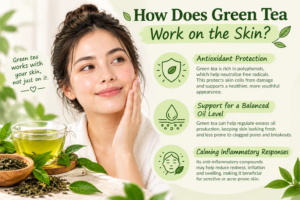
1. Antioxidant protection
Skin is exposed to environmental stressors such as ultraviolet (UV) radiation and air pollution. These can contribute to oxidative stress, which may affect the skin’s natural protective structures.
Green tea catechins have antioxidant activity. When included in suitable skincare formulations, they may offer some supportive protection against oxidative stress.
Still, green tea is not a substitute for sunscreen. A broad-spectrum sunscreen with SPF 30 or higher remains an important part of daily skincare.
2. Support for a balanced oil level
Sebum is the natural oil produced by the skin’s sebaceous glands. The skin needs some sebum to maintain its protective barrier, but excess production can contribute to oily skin and clogged pores.
Some studies suggest that topical green tea extract, especially formulations containing EGCG, may help reduce sebum production.
This is one reason green tea for oily and acne-prone skin has attracted interest. However, results may vary, and a green tea product should not be expected to control oil completely.
3. Calming inflammatory responses
Inflammation plays a role in acne, causing some blemishes to become red, swollen, and tender.
Green tea compounds have shown anti-inflammatory effects in laboratory and some human studies. These findings suggest that certain formulations may help calm visible irritation.
That does not mean green tea will treat every cause of redness. Conditions such as rosacea, eczema, allergic reactions, and skin infections need different approaches.
Benefits of Green Tea for Skin
Green tea may be useful in a skincare routine, particularly if your skin tends to become oily or develops occasional inflammatory blemishes. The strongest evidence relates to topical green tea extract and its potential effects on acne lesions and sebum production. More research is needed to establish how well it works for other skin concerns.
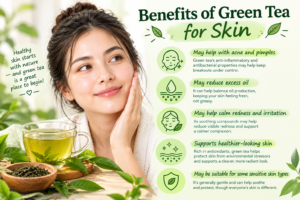
1. May help with acne and pimples
Does green tea help acne? Early clinical research suggests that topical green tea extract may reduce some acne lesions, particularly inflamed pimples.
A systematic review and meta-analysis published in 2021 examined five randomized controlled trials involving 247 participants. The researchers found that topical green tea extract was associated with fewer inflammatory acne lesions. However, the studies were relatively small, and more high-quality research is needed.This means green tea may be worth considering as a supportive skincare ingredient, but results aren’t guaranteed.
It may be less useful for stubborn blackheads, deep cysts, or severe acne that requires medical treatment.
2. May reduce excess oil
If your face looks shiny a few hours after cleansing, excess sebum may be contributing to the problem.
Some clinical research suggests that topical green tea formulations can reduce sebum production. This may make them useful for people with oily skin, although results depend on the formula and individual skin response.
Green tea won’t eliminate natural oil production, nor should it. Your skin needs some oil to maintain a healthy barrier.
For oily skin, combine a suitable green tea product with a gentle cleanser and a lightweight, non-comedogenic moisturizer.
3. May help calm redness and irritation
Green tea contains compounds with anti-inflammatory properties, which may help reduce some forms of skin inflammation.
This makes green tea for redness and irritated skin an area of interest. However, the evidence is more limited than many skincare claims suggest.
Redness can result from acne, rosacea, eczema, sunburn, allergies, or irritation from active skincare ingredients. Green tea isn’t an established treatment for all these conditions.
If redness persists, feels painful, or comes with swelling or itching, identify the underlying cause rather than relying on a home remedy.
4. Supports healthier-looking skin
Antioxidants help protect cells from oxidative stress. Green tea catechins have been studied for their antioxidant activity, including their potential role in protecting the skin from environmental damage.
A well-formulated green tea skincare product may complement a routine that supports healthy-looking skin. However, there is limited evidence that green tea alone produces dramatic changes in skin texture, firmness, or overall appearance.
For a natural-looking glow, focus on consistent cleansing, moisturizing, and sun protection rather than expecting one ingredient to transform your complexion.
5. May be suitable for some sensitive skin types
Green tea is sometimes included in products designed for sensitive or easily irritated skin because of its potential anti-inflammatory properties.
Still, natural doesn’t automatically mean gentle. A green tea serum may also contain fragrance, essential oils, alcohol, or other ingredients that irritate certain skin types.
If you have sensitive skin, choose a simple, fragrance-free formula and test it before applying it across your face.
How to Use Green Tea on Your Face
There are several ways to include green tea in your skincare routine. A formulated skincare product is generally more predictable than a homemade mixture because its ingredients and preservation system are controlled.

1. Use a green tea serum
Choose a facial serum containing green tea extract if you want to explore its potential benefits for oily or acne-prone skin. Apply it according to the product label, then use moisturizer. Introduce it gradually rather than adding several new products at once.

2. Try cooled, freshly brewed green tea cautiously
Brew plain green tea, let it cool completely, and apply a small amount to a limited area using clean hands or a clean cotton pad. Avoid the eyes and broken skin. Stop if you notice stinging, itching, or increased redness. Evidence for homemade brewed tea is limited, and it isn’t equivalent to a tested skincare formula. 3. Choose a green tea moisturizer
If your skin is dry or sensitive, a moisturizer containing green tea extract may be more practical than using tea on its own. Look for a formula that also helps maintain the skin barrier and doesn’t leave your skin feeling tight.
A simple green tea skincare routine
You don’t need a complicated routine to try this ingredient.
Morning
-
Wash your face with a gentle cleanser.
-
Apply your green tea serum or moisturizer if your skin tolerates it.
-
Use a moisturizer suited to your skin type.
-
Finish with broad-spectrum SPF 30 or higher.
Evening
-
Remove makeup and sunscreen, then cleanse gently.
-
Apply your green tea product according to its instructions.
-
Use a moisturizer to help maintain the skin barrier.
If you’re already using acne treatments such as benzoyl peroxide, salicylic acid, or a topical retinoid, introduce new products cautiously. Combining several products at once can make irritation harder to identify.
Green Tea Face Mask Benefits: Does a Homemade Mask Work?
Green tea face masks are popular among people who prefer simple, at-home skincare. A mask made with brewed tea may feel cooling, while a commercial mask containing green tea extract may offer a more consistent formulation.
However, there is not enough strong evidence to conclude that homemade green tea masks reliably treat acne, fade dark spots, or create long-lasting glowing skin.
A cautious way to try a simple green tea mask
If you want to experiment, keep it simple.
-
Brew plain green tea using clean water.
-
Allow it to cool completely.
-
Wash your hands and face gently.
-
Apply a small amount to a limited area of intact skin.
-
Rinse it off if you experience discomfort, and don’t leave homemade mixtures on your face overnight.
This is a cautious home-use approach, not a clinically proven acne treatment. Avoid mixing green tea with lemon juice, baking soda, essential oils, or harsh exfoliants.
Why should you avoid complicated DIY masks?
Kitchen ingredients can affect skin differently from tested cosmetic formulations. Lemon juice, for example, can irritate skin, while rough particles can cause friction. Food-based mixtures can also become contaminated when handled or stored improperly.
If you have active acne, eczema, rosacea, or a damaged skin barrier, a simple, well-formulated product is generally a better starting point than an experimental mask.
Is Green Tea Good for Oily, Acne-Prone, and Sensitive Skin?
The answer depends on your skin type and the product you use.
| Skin type | Potential benefit | What to keep in mind |
|---|---|---|
| Oily skin | May help reduce excess sebum | Use a gentle cleanser; avoid trying to remove all natural oil |
| Acne-prone skin | May support the management of inflammatory blemishes | It isn’t a replacement for established acne treatments |
| Sensitive skin | Some formulas may be well tolerated | Choose fragrance-free products and test first |
| Dry skin | May complement a moisturizing routine | Green tea alone won’t restore lost moisture |
| Redness-prone skin | May help with certain inflammatory responses | Persistent redness needs proper assessment |
Green tea isn’t guaranteed to suit every skin type. Even a product marketed for sensitive skin can cause a reaction in an individual who is sensitive to one of its ingredients.
Possible Side Effects and Safety Precautions
Topical green tea extract has generally appeared well tolerated in the small studies available, but the evidence is not extensive enough to guarantee that every product or homemade preparation is safe for everyone.
Keep these precautions in mind:
-
Test before use. Apply the product to a small area first. The American Academy of Dermatology recommends testing new skincare products on a small area twice daily for seven to ten days when practical.
-
Watch for irritation. Burning, itching, swelling, or worsening redness are reasons to stop using the product.
-
Avoid damaged skin. Don’t experiment with homemade mixtures on open pimples, cuts, or severely irritated areas.
-
Keep homemade preparations fresh. Don’t store brewed tea or DIY masks for repeated facial use without a suitable preservation system.
-
Don’t skip sunscreen. Green tea is not a substitute for sun protection.
-
Seek medical advice when needed. Painful nodules, scarring acne, persistent redness, or symptoms that worsen deserve professional assessment.
If you develop marked swelling, blistering, or a severe reaction, stop the product and seek medical care.
Common Mistakes to Avoid When Using Green Tea for Skin
Even a potentially helpful ingredient can disappoint if you use it incorrectly. These are some common mistakes worth avoiding.
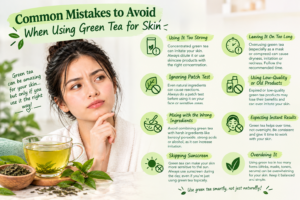
1. Expecting overnight results
Green tea won’t clear acne or reduce redness overnight. Skin changes take time, and the results of green tea products vary. Give a suitable routine time to work, but don’t continue using a product that causes irritation.
2. Applying hot tea to your face
Hot liquids can burn or irritate your skin. If you use freshly brewed tea, let it cool completely before it touches your face.
3. Using green tea instead of acne medication
Green tea extract has promising early evidence, but it isn’t among the treatments that current American Academy of Dermatology guidelines strongly recommend for acne. Established options include topical retinoids and benzoyl peroxide, depending on the type and severity of acne.
4. Assuming every green tea product is the same
A serum containing a standardized extract is different from a homemade cup of tea. Concentration, formulation, stability, and other ingredients can affect how a product performs.
5. Using too many new products at once
Adding a green tea serum, exfoliating toner, acne treatment, and face mask together can overwhelm an already irritated routine. Introduce one new product at a time so you can identify what helps and what causes a reaction.
How Long Does Green Tea Take to Work on Skin?
There is no established timeline for seeing results from green tea skincare. The time required depends on the formulation, the skin concern, and how consistently the product is used.
Here’s a practical guide to setting expectations:
-
Immediate feel: A cooled preparation may temporarily feel refreshing, but this doesn’t prove that it treats acne or inflammation.
-
Oil control: Changes, if any, depend on the product and the individual.
-
Acne improvement: Clinical studies have investigated topical green tea over several weeks. Results cannot be generalized to every serum or homemade treatment.
-
Persistent redness: Improvement depends on the underlying cause. Redness caused by rosacea or eczema may require condition-specific treatment.
Take note of changes in your skin rather than relying on a fixed number of days. If acne becomes painful, starts scarring, or fails to improve with appropriate care, consult a dermatologist.
Frequently Asked Questions
1. Does green tea help acne?
Green tea extract may help reduce inflammatory acne lesions, according to a systematic review of five randomized controlled trials. However, the available studies are limited, and green tea should be viewed as a possible supportive ingredient rather than a proven standalone acne treatment.
2. Can I apply green tea to my face every day?
Possibly, if you’re using a properly formulated product that your skin tolerates and the label permits daily use. Introduce it gradually and stop if irritation develops. Daily use of homemade green tea preparations has not been adequately studied.
3. Is green tea good for oily skin?
Green tea extract may help reduce excess sebum production, making it a potential option for oily skin. Choose a suitable facial product and continue using a gentle cleanser and moisturizer.
4. Can green tea reduce facial redness?
Green tea contains compounds with anti-inflammatory properties, but evidence for treating facial redness is limited. It may not help redness caused by rosacea, eczema, allergies, or other medical conditions.
5. Is green tea safe for sensitive skin?
Some people with sensitive skin may tolerate green tea products well, but reactions are still possible. Choose a fragrance-free formula and test it before applying it to your entire face.
6. Can green tea make my skin glow?
Green tea may complement a skincare routine that supports healthy-looking skin, but there is limited evidence that it directly creates a lasting glow. Gentle cleansing, adequate moisturizing, and sun protection are more dependable foundations.
7. Can I use green tea and aloe vera together?
They may be compatible in a properly formulated skincare product. If you mix them at home, however, the mixture won’t have the same tested stability or preservation as a commercial formula. Test each ingredient separately first and avoid applying the mixture to broken or irritated skin.
8. Is drinking green tea better for acne than applying it?
Neither approach is established as a reliable acne treatment. Research suggests topical green tea extract may be more promising for acne lesions than oral green tea extract, but further high-quality studies are needed. Drinking green tea can be part of a balanced diet, but it shouldn’t replace acne care.
9. Can green tea remove acne scars and dark spots?
There isn’t strong evidence that green tea alone removes established acne scars or reliably fades post-acne dark spots. Sun protection and appropriate treatments for post-inflammatory hyperpigmentation are more established approaches. Indented or raised scars may require professional treatment.
10. Can I leave green tea on my face overnight?
It’s better not to leave homemade brewed tea on your face overnight. It isn’t designed or preserved as a leave-on skincare product. If you want an overnight treatment, choose a formulated product intended for that purpose and follow its instructions.
Final Thoughts
Green tea for skin is worth understanding if you’re looking for supportive care for oily skin, occasional pimples, or mild irritation. Its antioxidant and anti-inflammatory compounds have shown promise, and early clinical research suggests that topical green tea extract may help reduce some acne lesions and excess oil.
Still, natural ingredients aren’t automatically effective or suitable for everyone. Homemade green tea masks have limited evidence, and green tea cannot replace proven treatments for persistent acne or unexplained redness.
For healthier-looking skin, keep your routine simple: cleanse gently, moisturize regularly, wear sunscreen, and introduce new products carefully. If you choose to try green tea, treat it as one possible addition to that routine—not a miracle cure.