
Using several beauty products isn’t automatically a problem. The trouble starts when your routine becomes so crowded that your skin no longer tolerates it well. Beauty overload happens when too many products, active ingredients, or frequent treatments overwhelm your skin, causing irritation, dryness, breakouts, or a weakened skin barrier. Recognizing the signs early can help you simplify your routine before the problem gets worse.
What Is Beauty Overload?
Beauty overload refers to using more beauty or skincare products than your skin reasonably needs or can tolerate.
A routine might include a cleanser, toner, essence, several serums, exfoliants, masks, spot treatments, moisturizers, oils, and other products. Each product may have a useful purpose on its own, but combining too many of them can make it difficult to know what your skin actually needs.
The problem isn’t simply the number of products. It also depends on:
- The ingredients they contain
- How frequently you use them
- Whether several products contain similar active ingredients
- Your skin type and sensitivity
- Whether you introduce products gradually
- How much exfoliation your skin receives
- Whether your skin barrier is already compromised
For example, using multiple products containing strong exfoliating acids or retinoids can be more irritating than using several gentle, basic products.
Why Does Using Too Many Beauty Products Cause Problems?
Your skin has a protective outer layer called the skin barrier. It helps reduce water loss and protects the skin from environmental irritants.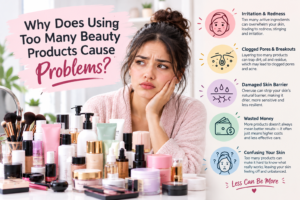
When your routine repeatedly exposes the skin to irritating ingredients, excessive cleansing, aggressive exfoliation, or too many treatments, the barrier may become disrupted.
This can lead to:
- Dryness and tightness
- Redness
- Burning or stinging
- Flaking
- Increased sensitivity
- Rough texture
- Breakouts
- Greater discomfort when applying normally tolerated products
This doesn’t mean every active ingredient is harmful. Ingredients such as retinoids, exfoliating acids, and acne treatments can be useful when used appropriately. The issue is often too much, too often, or too many overlapping treatments.
10 Signs You’re Using Too Many Beauty Products
If you’ve recently expanded your routine and your skin suddenly feels worse, look for these warning signs.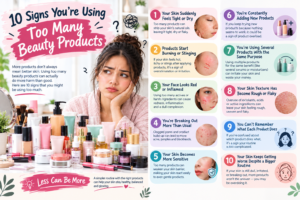
1. Your Skin Suddenly Feels Tight or Dry
Persistent tightness after cleansing or throughout the day can indicate that your routine is too harsh.
You may notice that your skin feels uncomfortable even after applying moisturizer. Flaking or rough patches can also appear.
Dryness can have many causes, though, including weather, hot water, over-cleansing, or a naturally dry skin type. Consider your entire routine rather than blaming one product immediately.
2. Products Start Burning or Stinging
A little tingling isn’t something you should automatically accept as proof that a skincare product is working.
If products that normally feel comfortable suddenly sting, burn, or cause discomfort, your skin may be irritated.
Pay particular attention if several products produce this reaction.
3. Your Face Looks Red or Inflamed
Unexpected redness is another common sign of skincare product irritation.
You might notice:
- Red patches
- Increased warmth
- Persistent flushing
- Irritated areas around the nose or cheeks
- Redness after applying products
If redness repeatedly appears after using several products, simplifying your routine may help identify what is causing the problem.
4. You’re Breaking Out More Than Usual
More products don’t necessarily mean clearer skin.
When your routine becomes complicated, breakouts may become harder to understand. You might be introducing several new products at once, making it difficult to identify which one is contributing to the problem.
Breakouts can also have many causes, so don’t assume that every pimple means a product is “purging.”
5. Your Skin Becomes More Sensitive
If your skin suddenly reacts to products, temperature changes, shaving, or environmental conditions that previously didn’t bother you, your routine may need a closer look.
Increased sensitivity can occur when the skin barrier becomes irritated or compromised.
6. You’re Constantly Adding New Products
Do you keep thinking, “Maybe I need another serum”?
This can create a cycle of beauty product overload.
Instead of giving a routine enough time to work, you continually add new products whenever you don’t see immediate results.
A simpler routine makes it easier to understand what’s actually helping.
7. You’re Using Several Products With the Same Purpose
You don’t necessarily need three different products targeting the same concern.
For example, a routine could contain multiple products marketed for:
- Exfoliation
- Brightening
- Acne
- Hydration
- Anti-aging
Some of these products may also contain overlapping active ingredients.
The result can be unnecessary duplication and increased irritation without providing a proportional benefit.
8. Your Skin Texture Has Become Rough or Flaky
Ironically, using more products to improve texture can sometimes make texture look worse.
Over-exfoliation and irritation may leave skin looking rough, uneven, or flaky.
If you’ve recently increased exfoliating products and your skin has become rougher rather than smoother, that’s a good reason to step back.
9. You Can’t Remember What Each Product Does
A routine should make sense to you.
If you’re applying products simply because you’ve seen them recommended somewhere but can’t explain what each one contributes, you may have more products than you need.
Understanding the purpose of each step is more useful than collecting products.
10. Your Skin Keeps Getting Worse Despite a Bigger Routine
One of the clearest warning signs is that your routine is becoming more complicated while your skin is becoming less comfortable.
If you keep adding products but experience increasing dryness, redness, irritation, or breakouts, more products may not be the answer.
Sometimes the best next step is to simplify rather than add.
Signs of Using Too Many Skincare Products vs. Normal Skin Changes
Not every skin problem means you have skincare product overload.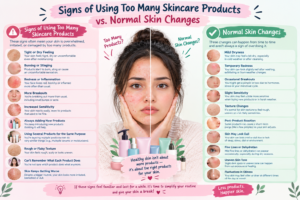
Your skin can change because of:
- Weather and humidity
- Hormonal changes
- Stress
- Lack of sleep
- New medications
- Allergies
- Diet or lifestyle changes
- Shaving or hair removal
- Existing skin conditions
The timing of symptoms can provide a useful clue.
If irritation appeared shortly after adding several new products, your routine deserves particular attention.
However, don’t assume that timing proves a specific product caused the reaction.
Which Products Are More Likely to Cause Overload?
The risk depends on the formulation and how you use it, rather than simply whether a product belongs to a particular category.
Still, routines can become more irritating when they contain several active treatments, such as:
- Retinoids
- Alpha hydroxy acids (AHAs)
- Beta hydroxy acids (BHAs)
- Strong exfoliating treatments
- Acne treatments
- Certain concentrated brightening products
- Frequent peeling products
Using these ingredients isn’t inherently bad. Many people use them successfully.
The concern is stacking several potentially irritating treatments without giving the skin enough time to adjust.
What Is a Damaged Skin Barrier?
The skin barrier is the outermost protective part of your skin. It helps keep moisture in and protects against external irritants.
When the barrier becomes disrupted, skin may feel:
- Dry
- Tight
- Rough
- Sensitive
- Irritated
- Flaky
You may also find that products that were previously comfortable now sting.
The phrase “damaged skin barrier from products” is commonly used online, but barrier disruption can have many causes. Overuse of skincare products is just one possible contributor.
How to Reset an Overloaded Skincare Routine
If your skin seems overwhelmed, you don’t necessarily need another specialized product. A simpler routine can make it easier to identify what your skin tolerates.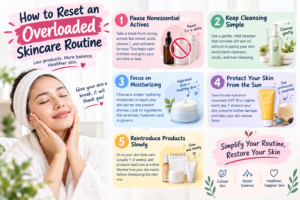
Step 1: Pause Nonessential Actives
Temporarily consider reducing products that are primarily focused on exfoliation, resurfacing, or intensive treatment if they’re contributing to irritation.
Don’t abruptly stop prescribed medication without speaking with your healthcare professional.
Step 2: Keep Cleansing Simple
Use a gentle cleanser appropriate for your skin and avoid excessive washing or scrubbing.
Very hot water and aggressive physical exfoliation can make irritation worse.
Step 3: Focus on Moisturizing
A basic moisturizer can help support comfortable, hydrated skin.
Look for a formulation that your skin already tolerates rather than introducing several new products during an irritation episode.
Step 4: Protect Your Skin From the Sun
Daily broad-spectrum sunscreen is an important part of a basic skincare routine, particularly when you’re concerned about sun exposure or using ingredients that can increase sensitivity.
Step 5: Reintroduce Products Slowly
Once your skin feels comfortable again, don’t immediately restart everything.
Bring products back gradually so you can observe how your skin responds.
This is especially useful when you’ve recently introduced several new products.
A Simple Routine to Avoid Skincare Product Overload
A basic routine doesn’t need to be complicated.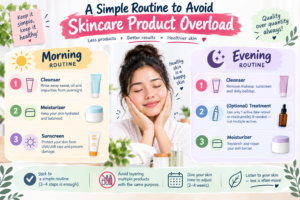
Morning
- Gentle cleanser, if needed
- Moisturizer
- Broad-spectrum sunscreen
Evening
- Gentle cleanser
- One treatment product, if appropriate for your skin
- Moisturizer
This is only a general framework. Some people need fewer steps, while others may need additional products for specific concerns.
The goal isn’t to use as few products as possible. It’s to use the products your skin actually needs and tolerates.
How to Prevent Beauty Product Overload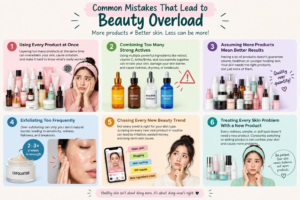
Introduce One New Product at a Time
Adding several products simultaneously makes it difficult to determine which one is helping or irritating your skin.
Introducing products individually gives you a clearer picture.
Avoid Constantly Changing Your Routine
Skin doesn’t necessarily improve faster because you change products frequently.
Give your routine reasonable consistency unless a product is clearly irritating or otherwise unsuitable.
Check for Overlapping Ingredients
Read ingredient lists when possible.
You may discover that several products in your routine are designed to perform similar functions or contain similar active ingredients.
Don’t Exfoliate Just Because You Can
Exfoliation can help certain skin types and concerns, but more frequent exfoliation isn’t automatically better.
If your skin becomes dry, irritated, or unusually sensitive, reconsider how often you’re exfoliating.
Pay Attention to Your Skin
Your skin can tell you when something isn’t working.
Persistent burning, redness, excessive dryness, or discomfort shouldn’t be treated as a sign that a product is necessarily “working.”
Keep Your Routine Practical
A good routine is one you can understand and follow consistently.
You don’t need a long list of products to take good care of your skin.
Common Mistakes That Lead to Beauty Overload
Using Every Product at Once
Trying multiple new products simultaneously makes troubleshooting difficult.
Combining Too Many Strong Actives
Several effective ingredients can become irritating when layered without a sensible plan.
Assuming More Products Mean Better Results
A longer routine isn’t automatically more effective.
Exfoliating Too Frequently
Over-exfoliation can leave the skin dry and irritated.
Chasing Every New Beauty Trend
Not every popular ingredient or technique belongs in your routine.
Treating Every Skin Problem With a New Product
Sometimes the right response to irritation is to remove potential triggers rather than add another treatment.
When Should You See a Dermatologist?
Consider professional advice if your skin remains irritated despite simplifying your routine, or if symptoms are severe or persistent.
It’s especially important to seek medical advice for:
- Significant swelling
- Severe or worsening redness
- Painful skin reactions
- Blistering
- Oozing or crusting
- Persistent rash
- Severe acne
- Symptoms affecting your eyes or breathing
A dermatologist can help determine whether you’re dealing with product irritation, an allergic reaction, acne, eczema, another skin condition, or something unrelated to your beauty routine.
Beauty Overload Isn’t Just About Skincare
The same principle can apply to hair and body care.
Using numerous hair treatments, styling products, scalp treatments, and frequent chemical services can make it difficult to determine what’s affecting your hair or scalp.
Likewise, repeatedly scrubbing, fragrancing, or treating the skin on your body can sometimes cause irritation.
A useful question is:
Does every product in my routine have a clear purpose?
If the answer is no, your routine may benefit from some editing.
Key Takeaways
- Beauty overload happens when your routine contains more products or treatments than your skin can comfortably tolerate.
- The number of products isn’t the only issue; ingredient combinations and frequency matter.
- Burning, redness, tightness, flaking, sensitivity, and new breakouts can indicate irritation.
- Using too many active ingredients can increase the risk of skincare product irritation.
- A simpler routine can make it easier to identify potential triggers.
- Introduce new products gradually rather than changing everything at once.
- Don’t assume that irritation means a product is working.
- Persistent or severe skin reactions should be evaluated by a healthcare professional.
Frequently Asked Questions
1. What are the signs of using too many beauty products?
Common signs include dryness, tightness, burning, redness, flaking, increased sensitivity, rough texture, and new or worsening breakouts. If these symptoms appear after adding several products, your routine may be overwhelming your skin.
2. Can using too many skincare products damage your skin barrier?
Yes, excessive cleansing, frequent exfoliation, and repeated exposure to irritating active ingredients can contribute to skin barrier disruption. However, barrier problems can also have other causes.
3. How many skincare products are too many?
There isn’t a universal number. A routine with several products can work well for one person but irritate another. What matters most is whether the products serve useful purposes and whether your skin tolerates them.
4. Can too many serums cause skin irritation?
They can, particularly when several serums contain potentially irritating active ingredients or are layered too frequently. More serums don’t necessarily produce better results.
5. Should I stop all skincare products if my skin is irritated?
Not necessarily. A gentler approach is usually to simplify your routine and avoid products that may be contributing to irritation. If you’re using prescribed treatments, ask your healthcare professional before stopping them.
6. How can I tell if my skincare routine is too complicated?
If you use many products with overlapping purposes, frequently add new products, can’t identify what is helping, or regularly experience irritation, your routine may be more complicated than necessary.
7. Can using too many products cause acne?
It can contribute to breakouts in some people, particularly if products are irritating, unsuitable for the skin, or difficult to tolerate. However, acne has many possible causes.
8. How long does it take for an irritated skin barrier to feel better?
It varies depending on the cause and severity of the irritation. Mild irritation may improve after removing the trigger and simplifying care, while persistent or significant symptoms may require professional evaluation.
9. Is a simple skincare routine better than a long routine?
Not automatically. A simple routine can be easier to maintain and troubleshoot, but the best routine depends on your skin type, concerns, products, and tolerance.
10. When should I see a dermatologist for product irritation?
Seek professional advice when irritation is severe, persistent, worsening, or accompanied by significant swelling, blistering, pain, oozing, or other concerning symptoms.
Final Thoughts
A good beauty routine isn’t measured by how many products sit on your shelf. It’s measured by how well the routine fits your skin and your actual needs.
If your skin has become unusually dry, sensitive, red, rough, or uncomfortable after expanding your routine, beauty product overload may be worth considering. Instead of adding another product to fix the problem, take a step back and review what you’re already using.