
Hair oiling has been used for generations as a simple way to condition the hair and care for the scalp. The benefits of hair oiling may include reducing dryness, improving softness, adding shine, and minimizing friction during washing and styling. A regular hair oiling routine can also help keep hair feeling smoother and more manageable. However, hair oiling for hair growth isn’t guaranteed, and the best hair oil depends on your hair type, scalp condition, and individual needs.
What Is Hair Oiling and How Does It Work?
Hair oiling is the practice of applying a small amount of oil to the scalp, hair lengths, or both. The oil is usually left on for a period of time before the hair is washed.
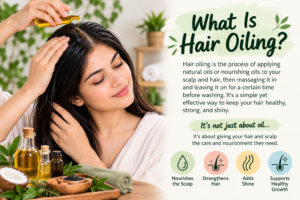
People oil their hair for different reasons. Some use it to manage dryness and frizz, while others include it in a regular hair care routine to make their hair feel softer and easier to handle.
The important thing is to match the oiling method to your hair type, scalp condition, and personal needs.
Hair Oiling Benefits: What Are the Benefits of Hair Oiling?
The benefits of hair oiling depend on the oil used, how it’s applied, and the condition of the hair and scalp. For many people, the main benefit is improved hair conditioning rather than hair growth.
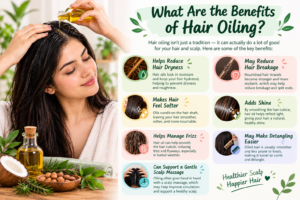
1. Helps Reduce Hair Dryness
Hair oils can coat the hair surface and help reduce moisture loss and friction. This can make dry hair feel smoother and more manageable.
This is particularly useful if your hair feels rough after shampooing or becomes dry easily.
2. May Reduce Hair Breakage
Dry, rough hair is more vulnerable to mechanical damage from brushing, combing, towel drying, and styling.
Using an appropriate oil may make the hair easier to detangle and reduce friction. This can help limit breakage caused by handling.
However, oil can’t repair a severely damaged strand. Once the hair fiber has split or broken, trimming is the only permanent way to remove that damage.
3. Makes Hair Feel Softer
One of the most noticeable benefits of hair oiling is improved softness.
Oils can smooth the hair surface, making strands feel less rough and helping them appear healthier.
4. Adds Shine
A light coating of oil can reflect light from the hair surface, creating a smoother and shinier appearance.
The effect is temporary, but it can make dry or dull hair look more polished.
5. Helps Manage Frizz
Frizz often becomes more noticeable when hair is dry, porous, or exposed to humidity.
A small amount of oil applied to the lengths and ends can help smooth the surface of the hair and reduce the appearance of frizz.
6. May Make Detangling Easier
Applying a suitable oil before washing or combing can provide some slip between individual strands.
This may make tangled hair easier to handle and reduce the amount of pulling needed during detangling.
7. Can Support a Gentle Scalp Massage
If you massage the scalp while applying oil, the process can become a relaxing part of your hair care routine.
The benefit here isn’t necessarily the oil itself. Gentle massage can make the routine feel soothing, but vigorous rubbing isn’t necessary and may cause irritation.
Can Hair Oiling Help With Hair Growth?
Hair oiling is often promoted as a way to make hair grow faster, but the evidence isn’t strong enough to say that ordinary hair oiling directly increases hair growth.
Hair growth is influenced by many factors, including genetics, age, hormones, nutrition, medications, and overall health.
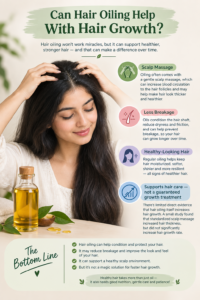
Some specific oils have been studied for possible effects on hair growth, but evidence varies considerably between ingredients. For example, research on rosemary oil has generated interest, but that doesn’t mean every natural oil has proven hair-growth benefits.
It’s also important to understand the difference between hair growth and hair retention.
If a conditioning routine reduces breakage, you may retain more of the hair you’ve already grown. That can make your hair appear longer or fuller over time without actually making the follicles produce hair faster.
Hair Oiling for Hair Growth: What to Expect
Think of oiling primarily as a conditioning and hair-care practice, not a guaranteed growth treatment.
If you’re experiencing sudden, severe, or persistent hair loss, it’s better to investigate the underlying cause rather than relying only on oiling.
Best Oils for Hair
There isn’t one universally best oil for everyone. The right choice depends on your hair texture, dryness, scalp condition, and how your hair responds to different products.
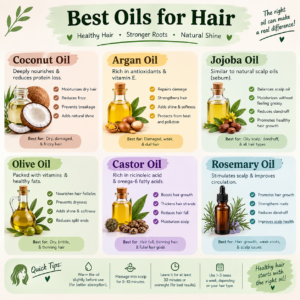
Here are some commonly used natural hair oils and what they’re generally used for.
Coconut Oil
Coconut oil is one of the most widely used oils for hair.
It has a strong affinity for the hair fiber and has been studied for its ability to reduce protein loss from hair. This makes it particularly interesting for people concerned about dryness and mechanical damage.
Best suited for:
- Dry or damaged hair
- Hair prone to breakage
- Pre-shampoo oiling
- Thick or coarse hair
Some people with fine hair may find coconut oil too heavy.
Argan Oil
Argan oil is lightweight compared with many heavier oils and is commonly used on the lengths and ends of hair.
It can help improve the feel and appearance of dry, rough hair.
Best suited for:
- Dry hair
- Frizzy hair
- Hair ends
- Adding shine
For many people, a tiny amount is enough.
Jojoba Oil
Jojoba oil has a texture that resembles some of the lipids naturally found on the skin.
It’s often used in hair and scalp products because it feels relatively lightweight.
Best suited for:
- Dry hair
- Dry-feeling scalp
- Fine to medium hair when used sparingly
- Hair lengths and ends
Olive Oil
Olive oil is a heavier oil that can provide a strong conditioning effect.
It may work well for thick, coarse, or very dry hair, but it can feel greasy or difficult to remove from fine hair.
Best suited for:
- Thick hair
- Coarse hair
- Very dry hair
- Pre-shampoo treatments
Castor Oil
Castor oil is very thick and sticky.
It’s frequently marketed as a hair-growth oil, but claims that castor oil directly makes hair grow faster aren’t well established.
Because of its thickness, many people prefer mixing a small amount with a lighter oil rather than applying it heavily.
Best suited for:
- Very dry hair
- Sealing moisture into the ends
- Mixing with lighter oils
Rosemary Oil
Rosemary oil is an essential oil and should not normally be applied directly to the scalp in its undiluted form.
Some research has investigated rosemary oil for hair loss, but the evidence is still limited compared with established medical treatments.
If you use rosemary essential oil, dilute it properly in a suitable carrier oil and stop if irritation occurs.
Best suited for:
- People interested in incorporating rosemary into a hair-care routine
- Diluted scalp applications
It should not be treated as a guaranteed hair-growth solution.
Best Hair Oils for Dry Hair
Dry hair usually benefits more from conditioning and reducing friction than from using large quantities of oil.
Some commonly used options include:
| Oil | Common use |
|---|---|
| Coconut oil | Pre-shampoo conditioning |
| Argan oil | Frizz control and shine |
| Olive oil | Deep conditioning for coarse hair |
| Jojoba oil | Lightweight conditioning |
| Castor oil | Heavy moisture-sealing for dry areas |
The best choice depends on how your hair responds. If one oil leaves your hair greasy, stiff, or difficult to wash, using less—or switching to a lighter oil—may work better.
How to Oil Your Hair Properly
A simple hair oiling routine doesn’t need to be complicated.
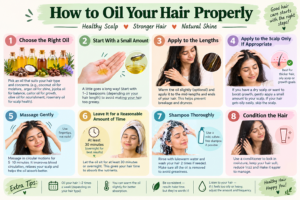
Step 1: Choose the Right Oil
Start with one oil rather than mixing several ingredients together.
Choose based on your hair’s needs.
For example:
- Dry, coarse hair → coconut or olive oil
- Frizzy hair → argan oil
- Fine hair → lightweight oil in a small amount
- Dry ends → a few drops of argan or jojoba oil
Step 2: Start With a Small Amount
You don’t need to saturate your hair.
Place a small amount of oil in your palms and spread it between your hands before applying.
Using too much oil doesn’t automatically provide more benefits.
Step 3: Apply to the Lengths
If your main concern is dryness, focus on the mid-lengths and ends.
These areas are older parts of the hair fiber and often experience more environmental and mechanical damage.
Step 4: Apply to the Scalp Only If Appropriate
Scalp oiling isn’t necessary for everyone.
If your scalp is dry and tolerates oil well, you may gently massage a small amount into it.
If you have an oily, acne-prone, irritated, or dandruff-prone scalp, heavy oiling may make your symptoms worse.
Step 5: Massage Gently
Use your fingertips rather than your fingernails.
A gentle massage is enough. There’s no need to scrub or aggressively rub the scalp.
Step 6: Leave It for a Reasonable Amount of Time
You don’t necessarily need to leave oil overnight.
Depending on your hair and scalp, a short pre-shampoo treatment may be sufficient.
Leaving oil on for extremely long periods doesn’t guarantee better results.
Step 7: Shampoo Thoroughly
Use enough shampoo to remove excess oil without aggressively scrubbing the hair.
If you applied a lot of oil, you may need a second gentle wash.
Step 8: Condition the Hair
Apply conditioner to the lengths and ends after shampooing.
This helps restore softness and makes detangling easier.
How Often Should You Oil Your Hair?
There is no universal schedule for hair oiling.
For many people, once or twice a week is enough if their hair benefits from oiling. Others may need it less often, while people with very dry or coarse hair may prefer a more regular conditioning routine.
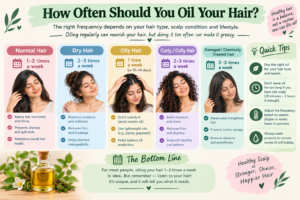
Your scalp and hair will tell you a lot.
You may need less oiling if:
- Your scalp becomes greasy quickly
- Your hair looks flat
- You develop scalp buildup
- Your hair feels coated
- Shampooing becomes difficult
You may benefit from occasional oiling if:
- Your hair feels dry
- Your ends feel rough
- Your hair becomes tangled easily
- Your hair feels more fragile after washing
- You use heat or chemical treatments regularly
The goal is not to follow a fixed schedule. It’s to find a routine your hair tolerates well.
Hair Oiling Routine for Different Hair Types
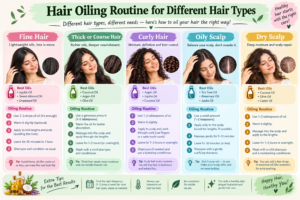
Fine Hair
Fine hair can become weighed down easily.
Use a lightweight oil and apply a small amount mainly to the ends.
Avoid heavily coating the scalp unless you know it works well for you.
Thick or Coarse Hair
Thicker hair may tolerate richer oils better.
Coconut or olive oil can be useful as a pre-shampoo treatment, especially when the hair feels dry.
Curly Hair
Curly hair can lose moisture more easily and may benefit from careful conditioning.
Use oil mainly to reduce friction and soften the lengths and ends.
Avoid relying on oil alone for moisture. Hair generally needs water-based conditioning products as well.
Oily Scalp
If your scalp becomes oily quickly, frequent scalp oiling may not be helpful.
Instead, focus oil on the dry lengths and ends if needed.
Dry Scalp
A dry-feeling scalp may tolerate occasional light oiling, but don’t assume every flaky scalp is simply “dry.”
Flaking can have different causes, including dandruff and inflammatory scalp conditions. Persistent itching or scaling may need professional evaluation.
Common Hair Oiling Mistakes
Hair oiling is simple, but some habits can make it less useful.
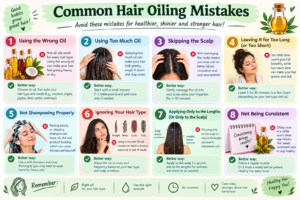
1. Using Too Much Oil
More oil doesn’t mean more nourishment.
Excess oil can make hair greasy, difficult to wash, and weighed down.
Better approach: Start with a small amount and add more only if necessary.
2. Leaving Oil on Overnight Automatically
Many people believe that oil must stay on the hair overnight to work.
That’s not necessarily true.
A shorter pre-shampoo treatment can be enough for conditioning purposes.
3. Rubbing the Scalp Too Hard
Aggressive massage can irritate the scalp and cause unnecessary mechanical stress.
Use gentle fingertip movements instead.
4. Applying Essential Oils Directly
Essential oils such as rosemary oil are highly concentrated.
Applying them undiluted can cause irritation or sensitization.
Always follow appropriate dilution guidance for essential oils.
5. Oiling an Irritated Scalp
If your scalp is already red, painful, itchy, or inflamed, adding oils may not solve the problem.
Some people may find that certain oils worsen irritation.
Identify the cause instead of assuming more oil is the answer.
6. Expecting Oil to Repair Split Ends
Once a hair strand has split, oil cannot permanently fuse it back together.
Oil may temporarily improve how damaged ends look and feel, but trimming is the only way to physically remove split ends.
7. Assuming Natural Means Risk-Free
Natural oils can still cause irritation or allergic reactions.
Patch testing and cautious use are sensible, particularly with essential oils and unfamiliar ingredients.
8. Using Heat Carelessly After Oiling
Applying oil before heat styling doesn’t automatically make hair heat-safe.
Hair exposed to high temperatures can still suffer damage.
Use appropriate heat protection and keep styling temperatures as low as practical.
Is Hair Oiling Good for Everyone?
No.
Hair oiling can be useful for many people, but it’s not essential for healthy hair.
You may want to limit or avoid scalp oiling if you have:
- An oily scalp
- Frequent scalp breakouts
- Irritation after using oils
- A condition that worsens with heavy products
- Product buildup
You can still use a small amount of oil on the lengths and ends if your hair needs conditioning.
The key is to distinguish scalp care from hair-fiber care. What works on your ends may not be appropriate for your scalp.
Hair Oiling vs Hair Conditioner
These two practices aren’t identical.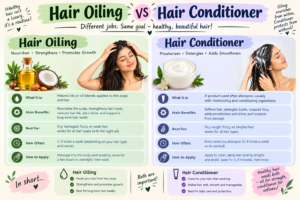
Hair oiling mainly involves using oils to coat and condition the hair, often before shampooing.
Conditioner is formulated to improve manageability, reduce friction, and condition the hair after cleansing.
For many people, conditioner is more important for everyday hair care than oiling.
A simple routine might therefore look like:
Shampoo → Conditioner → Leave-in product if needed → Small amount of oil on ends if needed
Or:
Oil treatment → Shampoo → Conditioner
The best option depends on your hair.
Can You Mix Different Hair Oils?
You can, but you don’t need to.
Mixing several oils doesn’t automatically make a treatment more effective.
In fact, using one oil at a time makes it easier to understand what your hair likes or dislikes.
If you want to mix oils, keep the formula simple and avoid adding multiple essential oils without understanding proper dilution.
Expert Tips for Better Hair Oiling
A few simple habits can make your routine more practical:
- Start with a small amount of oil.
- Focus on the lengths and ends when dryness is the main concern.
- Don’t aggressively massage the scalp.
- Don’t assume overnight oiling is necessary.
- Shampoo thoroughly after heavy oil treatments.
- Use conditioner after shampooing.
- Choose lighter oils if your hair becomes weighed down.
- Avoid putting essential oils directly on the skin.
- Stop using an oil if it causes itching, burning, redness, or irritation.
- Don’t depend on oiling alone for hair-growth concerns.
- If you’re experiencing significant hair loss, look for the underlying cause.
When Should You See a Doctor About Hair Loss?
Hair shedding can happen normally, but persistent or significant hair loss deserves attention.
Consider speaking with a dermatologist or other qualified healthcare professional if you notice:
- Sudden or substantial hair loss
- Bald patches
- A widening part
- Significant scalp itching or inflammation
- Pain or sores on the scalp
- Hair loss accompanied by other unexplained symptoms
- Hair loss that continues despite changes to your routine
Hair oils can condition the hair, but they can’t address every medical cause of hair loss.
Frequently Asked Questions About Hair Oiling
1. How often should you oil your hair?
For many people, once or twice a week is enough, but there’s no universal schedule. Your hair type, scalp condition, and lifestyle should determine how often you oil.
2. Does hair oiling increase hair growth?
Not necessarily. Hair oiling can improve conditioning and reduce breakage, which may help with hair retention. However, ordinary hair oiling isn’t a guaranteed way to increase the rate of hair growth.
3. Which oil is best for hair growth?
There isn’t one proven best oil for everyone. Some research has examined specific oils such as rosemary oil, but evidence is limited compared with established treatments for hair loss. The cause of hair loss matters more than simply choosing an oil.
4. Which oil is best for dry hair?
Coconut, argan, olive, and jojoba oils are commonly used for dry hair. Coconut and olive oils tend to feel richer, while argan and jojoba may feel lighter.
5. Can I oil my hair every day?
Daily oiling isn’t necessary for most people. It may leave the hair greasy or weighed down and can create buildup. If your ends are very dry, a tiny amount of lightweight oil may be enough.
6. Should I oil my scalp or hair ends?
It depends on your goal. For dry hair, focusing on the lengths and ends is often more useful. Scalp oiling isn’t necessary for everyone and may not suit oily or irritation-prone scalps.
7. Is it better to oil hair before or after shampooing?
Both approaches are possible, but they serve different purposes. A pre-shampoo oil treatment can provide conditioning, while a tiny amount of oil after washing can help smooth dry ends and reduce frizz.
8. Can I leave hair oil overnight?
You can if your scalp and hair tolerate it, but overnight application isn’t required. A shorter pre-shampoo treatment may provide the conditioning you want without leaving the scalp coated for many hours.
9. Can hair oil fix split ends?
No. Oil can temporarily make split ends look smoother, but it can’t permanently repair a split hair fiber. Trimming is the only way to remove split ends.
10. Can I use rosemary essential oil directly on my scalp?
It’s generally better not to apply rosemary essential oil directly because essential oils are concentrated and can irritate the skin. If used, it should be appropriately diluted in a carrier oil.
Key Takeaways
Hair oiling can be a useful part of a simple hair care routine, especially when the goal is to improve softness, reduce friction, manage dryness, and make hair easier to handle.
The best oil for hair depends on your individual needs. Coconut oil may suit dry or damaged hair, argan oil can work well for frizz and shine, and jojoba oil offers a lighter option for some people.
However, oiling isn’t a magic solution for hair growth or hair loss. Using too much oil, aggressively massaging the scalp, or applying essential oils without proper dilution can cause problems.
A better approach is simple: choose an appropriate oil, use a small amount, apply it gently, wash it properly, and pay attention to how your hair and scalp respond.
Final Thoughts
Hair oiling doesn’t need to be complicated. You don’t need a shelf full of oils or an elaborate routine to care for your hair.
Start with one suitable oil and a small amount. Focus on what your hair actually needs rather than following a fixed trend. If your hair is dry, use oil as a conditioning step. If your scalp is oily or irritated, you may be better off skipping scalp oiling.
And if you’re dealing with persistent hair loss, treat oiling as a supportive hair-care habit—not a substitute for finding the underlying cause.