
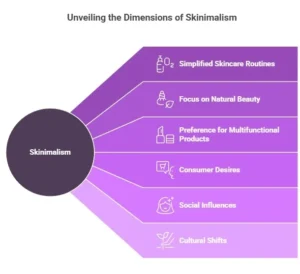
Skinimalism is a skincare approach that focuses on using fewer, more purposeful products instead of following a complicated routine with many steps. The goal isn’t to own the smallest possible number of products. It’s to identify what your skin actually needs, remove unnecessary steps, and build a simple routine that you can follow consistently.
For many people, skincare can become confusing. One product promises brighter skin, another targets pores, another claims to smooth fine lines, and another is designed to strengthen the skin barrier. Adding everything at once can make it difficult to know what’s actually helping.
That’s where skinimalism comes in.
A simple routine can often make skincare easier to understand and maintain. It can also reduce the chance of irritation caused by using too many active ingredients together.
This complete beginner’s guide explains what skinimalism means, how it works, its benefits and limitations, how to build a minimalist skincare routine, common mistakes to avoid, and how to adjust the routine for different skin types.
What Is Skinimalism?
Skinimalism is a minimalist approach to skincare that emphasizes a small number of effective products chosen according to your skin’s needs. Rather than using a long list of products, a skinimalist routine generally focuses on the basics: cleansing, moisturizing, and protecting the skin from the sun, with targeted treatments added only when they’re genuinely useful.
The idea is simple: use what your skin needs, not everything that’s available.

A skinimalist routine may contain only three to five products. For someone with specific concerns, such as acne or hyperpigmentation, a targeted treatment can be added without turning the routine into a dozen-step process.
Skinimalism isn’t about avoiding skincare ingredients or refusing to use active products. It’s about being intentional.
Skinimalism in simple terms
Think of your skincare routine like a wardrobe.
You don’t need twenty versions of the same basic shirt. You need a few reliable pieces that work well together and suit your needs.
Skincare can work the same way.

Instead of asking:
“What other product should I add?”
A skinimalist asks:
“Does my skin actually need this?”
That small change in thinking can make a routine much easier to manage.
Why Has Skinimalism Become Popular?
Skincare routines have become increasingly elaborate. It’s common to see routines involving cleansers, toners, essences, several serums, exfoliants, masks, eye creams, moisturizers, facial oils, and other treatments.
None of these products are automatically bad. The problem is that more products don’t necessarily mean better results.

A complicated routine can create several challenges:
- It’s harder to identify which product is helping.
- It can be easier to over-exfoliate.
- Multiple active ingredients may increase irritation.
- The routine can become expensive.
- Some people eventually stop following it because it takes too much time.
- Beginners may have difficulty understanding what their skin actually needs.
Skinimalism offers a simpler alternative.
The emphasis is on consistency, skin needs, and sensible product selection rather than the number of products used.
The Basic Principles of Skinimalism
Skinimalism isn’t a strict formula. Different people can follow minimalist routines with slightly different products.
However, several principles are at the heart of the approach.
1. Start With the Basics
A good skincare routine doesn’t need to begin with ten products.
The foundation is usually:
- Cleanser
- Moisturizer
- Sunscreen during the daytime
Once these basics are working well, you can consider whether you actually need a targeted treatment.
2. Understand Your Skin’s Needs
Your routine should be based on your skin rather than trends.
For example:
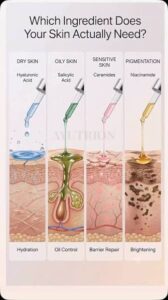
- Dry skin may need more hydration and barrier support.
- Oily skin may benefit from lightweight, non-comedogenic products.
- Sensitive skin often does better with fewer potentially irritating ingredients.
- Acne-prone skin may need a targeted acne treatment.
- Skin with uneven pigmentation may benefit from carefully selected brightening ingredients.
You don’t need to treat every possible skin concern at once.
Choose the concern that matters most to you.
3. Avoid Unnecessary Duplication
Using multiple products that perform essentially the same function can make a routine unnecessarily complicated.
For example, someone might use several hydrating serums, multiple moisturizers, and several products containing similar ingredients.
One well-chosen product may be enough.
4. Introduce Active Ingredients Carefully
Active ingredients can be useful, but more isn’t always better.
Ingredients such as retinoids, exfoliating acids, benzoyl peroxide, and other treatments can be helpful for specific concerns. However, introducing several strong treatments simultaneously can make irritation more likely.
A minimalist approach favors gradual introduction.
5. Give Products Time to Work
Constantly changing products makes it difficult to understand what is helping.
Unless a product is causing obvious irritation or another problem, give your routine enough time to evaluate how your skin responds.
Some concerns, such as dryness, may improve relatively quickly. Others, such as acne or uneven pigmentation, can take considerably longer to address.
What Products Do You Actually Need?
One of the biggest questions beginners have is how many products belong in a skinimalist routine.
There’s no universal number.
For many people, the essential routine can be remarkably simple.
Morning
Cleanser → Moisturizer → Sunscreen
Evening
Cleanser → Treatment if needed → Moisturizer
That’s it.
A person with dry skin may prefer a gentle cleanser or even a water rinse in the morning rather than cleansing twice daily. Someone with oily skin may prefer cleansing both morning and evening.
The correct routine depends on your skin.
Step-by-Step Skinimalism Routine for Beginners
If you’re starting from scratch, don’t feel pressured to build your perfect routine immediately.

Start with the fundamentals.
Step 1: Cleanse Your Skin
A cleanser removes sweat, excess oil, sunscreen, makeup, and other substances from the skin.
Choose a cleanser based on how your skin behaves.
Dry or sensitive skin
Look for a gentle cleanser that doesn’t leave your skin feeling tight or uncomfortable.
Oily skin
A lightweight cleanser can help remove excess oil without excessively stripping the skin.
Combination skin
A gentle cleanser is usually a good starting point.
Acne-prone skin
Look for products designed for acne-prone skin, but avoid assuming that stronger cleansing automatically means better acne control.
A cleanser shouldn’t leave your face feeling painfully dry.
Step 2: Moisturize
Moisturizer helps support the skin barrier and reduce water loss from the skin.
Even oily skin can benefit from moisturizing.
The texture can vary:
- Gel moisturizers may feel comfortable on oily skin.
- Lightweight lotions can work well for combination skin.
- Creams may be more comfortable for dry skin.
- Sensitive skin may benefit from simple formulas with fewer potential irritants.
If your moisturizer feels comfortable and doesn’t cause problems, there’s usually no need to keep switching.
Step 3: Apply Sunscreen in the Morning
Sunscreen is one of the most important parts of a daytime skincare routine.
UV exposure contributes to sunburn and long-term skin damage and can worsen some forms of hyperpigmentation.
For everyday use, choose a broad-spectrum sunscreen with an SPF appropriate for your needs and apply enough to adequately cover exposed skin.
Don’t forget areas such as the ears, neck, and other exposed areas.
If you’re spending extended time outdoors, reapplication is important, particularly after sweating, swimming, or towel drying.
Step 4: Add One Targeted Treatment
Once your basic routine is stable, you can decide whether you need a treatment product.
This is where skinimalism becomes personalized.
You don’t need a separate serum for every concern.
Choose one primary goal.
For example:
If your concern is acne
Depending on the type and severity of acne, ingredients such as salicylic acid or benzoyl peroxide may be useful.
If your concern is uneven pigmentation
Ingredients such as vitamin C, azelaic acid, niacinamide, or retinoids may be considered depending on the individual and the specific concern.
If your concern is dryness
A hydrating product containing ingredients such as glycerin or hyaluronic acid may help, although a good moisturizer may already provide sufficient hydration.
If your concern is signs of skin aging
Retinoids are among the better-studied topical ingredients for several signs of photoaging. They aren’t appropriate for everyone, and some forms should not be used during pregnancy.
The important point is to choose treatment based on a real need rather than adding an active ingredient simply because it’s trending.
Skinimalism for Different Skin Types
There isn’t one minimalist routine that works for everyone.

Your skin type and individual concerns should guide your choices.
Skinimalism for Dry Skin
Dry skin often benefits from a routine focused on maintaining the skin barrier and reducing moisture loss.
A simple routine might include:
Morning:
- Gentle cleanser or water rinse
- Moisturizer
- Sunscreen
Evening:
- Gentle cleanser
- Moisturizer
- Optional hydrating treatment
Avoid repeatedly using harsh cleansers or aggressive exfoliants if your skin is already dry or irritated.
Skinimalism for Oily Skin
Oily skin can still become dehydrated or irritated.
A minimalist routine may include:
Morning:
- Gentle cleanser
- Lightweight moisturizer
- Sunscreen
Evening:
- Cleanser
- Targeted acne or oil-control treatment if needed
- Lightweight moisturizer
Don’t try to remove every trace of oil from your skin. Excessively stripping the skin can make the routine uncomfortable and may worsen irritation.
Skinimalism for Combination Skin
Combination skin usually has areas with different characteristics.
You might notice oiliness around the forehead, nose, and chin while the cheeks feel normal or dry.
Start with products that are comfortable across the entire face.
If necessary, you can adjust the amount or texture of moisturizer in different areas rather than buying several separate products.
Skinimalism for Sensitive Skin
Sensitive skin often benefits from keeping the routine especially simple.
Start with:
- Gentle cleanser
- Basic moisturizer
- Sunscreen
Introduce new products one at a time.
Avoid adding several exfoliants or active ingredients at once.
If a product repeatedly causes burning, swelling, significant redness, or other concerning reactions, stop using it and consider speaking with a dermatologist.
Skinimalism for Acne-Prone Skin
Having acne doesn’t mean you need a complicated skincare routine.
In fact, a simple routine can make it easier to identify potential irritants.
A basic approach could be:
Morning:
- Gentle cleanser
- Lightweight moisturizer
- Sunscreen
Evening:
- Cleanser
- Appropriate acne treatment
- Moisturizer
The right acne treatment depends on the type and severity of acne.
Persistent, painful, cystic, or scarring acne deserves professional evaluation rather than endless experimentation with skincare products.
Skinimalism and the Skin Barrier
The skin barrier is an important part of healthy skin.
It helps reduce water loss and protects the body from external environmental factors.
When the barrier is irritated or disrupted, you may notice:
- Dryness
- Tightness
- Flaking
- Increased sensitivity
- Redness
- Burning or stinging when applying products
A minimalist routine can help because it reduces the number of products that could potentially irritate already-sensitive skin.
How to support your skin barrier
Focus on:
- Gentle cleansing
- Regular moisturizing
- Sun protection
- Avoiding unnecessary exfoliation
- Introducing active ingredients slowly
- Not constantly changing products
If your skin is irritated, simplifying the routine can be a sensible first step.
Is Skinimalism Good for Your Skin?
For many people, skinimalism can be a practical way to create a manageable skincare routine.
Its biggest advantage isn’t that fewer products are automatically healthier.

Instead, the benefit comes from using appropriate products consistently and avoiding unnecessary complexity.
A simple routine can make it easier to:
- Understand your skin
- Track changes
- Identify irritating products
- Maintain consistency
- Avoid excessive exfoliation
- Save time
- Reduce unnecessary spending
However, minimalist skincare isn’t a medical treatment by itself.
Someone with a skin condition may need a more specialized routine recommended by a dermatologist.
Benefits of Skinimalism
1. It Makes Skincare Easier
A shorter routine is easier to remember and maintain.
Instead of spending a long time layering products, you can focus on the essentials.
2. It Reduces Product Overload
When you use fewer products, there are fewer ingredients to keep track of.
This is especially helpful for beginners.
3. It Can Reduce Unnecessary Irritation
Using many active ingredients may increase the possibility of irritation, especially when products are introduced too quickly.
A simpler routine makes it easier to avoid this problem.
4. It Makes Troubleshooting Easier
If your skin suddenly becomes irritated after adding one new product, identifying the potential cause is easier than when you’ve introduced five products simultaneously.
5. It Encourages Consistency
The best routine is one you can realistically follow.
A simple routine is often easier to maintain over time.
6. It Can Reduce Unnecessary Spending
You don’t need to purchase every new skincare product to care for your skin.
Choosing products based on actual needs can reduce impulse buying.
Are There Any Disadvantages to Skinimalism?
Skinimalism isn’t perfect for every situation.
Some people have multiple legitimate skin concerns that require different treatments.
For example, someone may need an acne treatment while also addressing dryness or pigmentation.
The goal shouldn’t be to remove useful treatments simply to reach an arbitrary number of products.
Another limitation is that some skincare routines need to be more carefully structured when using prescription treatments or multiple evidence-based therapies.
In those cases, a dermatologist can help determine which products should be used and how they should be combined.
Minimalism should mean intentional skincare—not inadequate skincare.
Skinimalism vs. a Traditional Multi-Step Routine
The main difference is the number and purpose of products.
| Skinimalism | Multi-Step Routine |
|---|---|
| Focuses on essential products | May include many products |
| Prioritizes individual skin needs | May target several concerns |
| Easier for beginners | Can require more knowledge |
| Usually takes less time | Can take longer |
| Fewer products to troubleshoot | More variables |
| Emphasizes simplicity | Emphasizes multiple treatment steps |
Neither approach is automatically better.
A person can have a longer routine and still use products thoughtfully.
The important question is whether each product serves a useful purpose.
How to Build a Skinimalist Routine
If your current routine has ten or more products, don’t necessarily throw everything away.

Instead, simplify gradually.
Start with these questions:
1. What is my biggest skin concern?
Choose one or two priorities.
2. Which products are essential?
Usually this means cleanser, moisturizer, and sunscreen.
3. Which products are actually helping?
Think about products you’ve used consistently and tolerated well.
4. Which products cause irritation?
Consider removing products that consistently make your skin uncomfortable.
5. Am I using several products for the same purpose?
If so, you may be able to eliminate duplicates.
A Simple 3-Product Skinimalist Routine
For someone who wants the absolute basics, a routine could look like this:
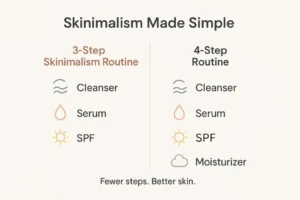
Morning
- Cleanser
- Moisturizer
- Sunscreen
Evening
- Cleanser
- Moisturizer
This is a perfectly reasonable starting point.
If you later identify a specific concern, you can add a targeted treatment.
A 4-Product Skinimalist Routine
For someone who wants one treatment step:
Morning
- Cleanser
- Moisturizer
- Sunscreen
Evening
- Cleanser
- Targeted treatment
- Moisturizer
The treatment can be selected according to the person’s primary concern.
A 5-Product Skinimalist Routine
A slightly more complete routine could include:
- Gentle cleanser
- Hydrating or treatment serum
- Moisturizer
- Sunscreen
- One specialized treatment
However, the number itself isn’t important.
If you don’t need the fifth product, don’t add it simply to reach five.
How to Choose Skincare Products for a Minimalist Routine
Product selection can feel overwhelming, particularly when packaging and marketing make every ingredient sound essential.
Start with function.
Look at the product’s purpose
Ask:
- What does this product do?
- Do I actually need that function?
- Is there already another product in my routine doing the same thing?
- Does it suit my skin?
- Can I use it consistently?
The goal is to choose products that have a clear role.
Don’t Choose Products Based Only on Trends
A product can be popular without being appropriate for your skin.
Trending ingredients come and go.
Instead of asking:
“Is everyone using this?”
Ask:
“Does this solve a problem I actually have?”
That question can prevent a lot of unnecessary experimentation.
How to Introduce New Products
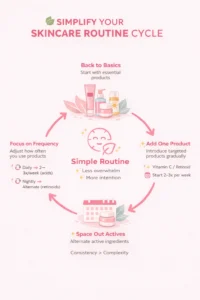
One of the smartest habits in skinimalism is introducing products gradually.
If you start three new products at once and develop irritation, you’ll have difficulty identifying the cause.
Instead:
- Keep your basic routine stable.
- Introduce one new product.
- Observe how your skin responds.
- Give yourself enough time to evaluate it.
- Add another product only when appropriate.
For products containing active ingredients, follow the manufacturer’s directions and don’t assume that using them more frequently will produce faster results.
Patch Testing and Skinimalism
Patch testing can be useful when introducing a new skincare product, particularly if you have sensitive skin or a history of reactions.
A small amount can be tested on an inconspicuous area according to the product’s instructions.
Keep in mind that a small-area test can’t guarantee that you’ll never react when the product is used on your entire face.
If you experience a significant reaction, stop using the product.
Common Skinimalism Mistakes
Simplifying your routine sounds easy, but there are still several mistakes to avoid.
Mistake 1: Thinking Fewer Products Always Means Better Skin
Three products aren’t automatically better than six.
The purpose is to eliminate unnecessary products—not useful ones.
Mistake 2: Removing Sunscreen
Sunscreen should not be treated as an optional extra simply because you’re following a minimalist routine.
Sun protection is a fundamental part of daytime skincare.
Mistake 3: Using Too Many Active Ingredients
A minimalist routine can still become complicated if every product contains a strong active ingredient.
Using several treatments simultaneously may increase irritation.
Mistake 4: Changing Products Too Frequently
If you’re constantly switching products, you won’t know which products are helping.
Give your routine enough time to evaluate its effect.
Mistake 5: Copying Someone Else’s Routine
Your friend’s skincare routine may work beautifully for them and poorly for you.
Skin differs from person to person.
Mistake 6: Treating Every Skin Concern at Once
You don’t have to solve dryness, acne, pigmentation, pores, texture, dullness, and fine lines simultaneously.
Start with your highest priority.
Mistake 7: Over-Exfoliating
Exfoliation can be useful for certain skin concerns, but frequent or aggressive exfoliation can irritate the skin.
If your skin is burning, peeling, or unusually sensitive, reconsider your exfoliation routine.
Skinimalism for Beginners: A 30-Day Approach
If you’re overwhelmed by your current routine, try simplifying it gradually.
Week 1: Identify the Essentials
Keep your routine focused on:
- Gentle cleansing
- Moisturizing
- Sunscreen
Pause unnecessary experimentation.
Week 2: Observe Your Skin
Pay attention to:
- Dryness
- Oiliness
- Redness
- Breakouts
- Sensitivity
- Overall comfort
Don’t feel pressured to add anything.
Week 3: Identify Your Main Concern
Choose the one issue you most want to address.
For example:
- Acne
- Dryness
- Uneven pigmentation
- Texture
- Signs of photoaging
Week 4: Consider One Treatment
If your basic routine is working well, consider adding one targeted product appropriate for your concern.
Introduce it gradually.
This approach helps you understand what your skin actually needs rather than constantly reacting to new trends.
Can Skinimalism Help Sensitive Skin?
It can be particularly practical for people who find that their skin becomes irritated easily.
Reducing the number of products reduces the number of ingredients your skin is exposed to.
However, skinimalism isn’t a cure for sensitive skin or dermatological conditions.
Persistent redness, itching, swelling, burning, rashes, or other unexplained symptoms should be evaluated by an appropriate healthcare professional.
Can You Use Serums With Skinimalism?
Yes.
Skinimalism doesn’t mean eliminating serums.
It means using a serum when it has a clear purpose.
For example, you might use:
- A hydrating serum for added hydration
- A niacinamide product for specific concerns
- A vitamin C product as part of a morning routine
- An acne-focused treatment
- A retinoid as part of an evening routine
But you don’t need five serums simply because they’re available.
Choose one that fits your needs.
Do You Need a Toner?
No, not everyone needs a toner.
Modern skincare routines don’t require toner as a mandatory step.
Some toners provide hydration or contain active ingredients that may be useful for particular skin concerns.
If you enjoy using one and it serves a purpose, there’s nothing wrong with including it.
But if you’re trying to simplify your routine, toner is one of the steps you can evaluate rather than automatically keeping.
Do You Need an Eye Cream?
Not necessarily.
The skin around the eyes is delicate, and some people prefer products specifically formulated for this area.
However, an eye cream isn’t automatically necessary for everyone.
If you have a specific concern around the eyes, such as dryness or puffiness, consider whether a suitable product is actually helping.
Avoid using irritating products too close to the eyes.
Do You Need a Face Oil?
Not necessarily.
Face oils can be useful for some people, particularly those who enjoy richer textures or need additional help reducing moisture loss.
But they’re optional.
A well-formulated moisturizer may be enough for many people.
Skinimalism and Makeup
Skinimalism can extend beyond skincare into makeup.
The broader idea is to create a natural-looking appearance with fewer products.
A simple makeup routine might include:
- Tinted moisturizer or foundation
- Concealer where needed
- Cream blush
- Brow product
- Mascara
- Lip product
The exact routine depends on personal preference.
However, skincare and makeup should still be treated as separate concepts. Minimalist makeup doesn’t mean skipping skincare or sun protection.
Skinimalism Doesn’t Mean “Natural” Skincare
This is an important distinction.
Skinimalism refers to how many products you use and how intentionally you choose them.
It doesn’t mean every product must be natural, organic, botanical, or homemade.
A synthetic ingredient isn’t automatically harmful, and a natural ingredient isn’t automatically gentle.
Evaluate skincare based on its formulation, purpose, tolerability, and evidence—not simply whether the label says “natural.”
Skinimalism and Dermatologist-Recommended Skincare
If you have a diagnosed skin condition or are using prescription medication, don’t simplify your routine without considering your treatment plan.
Conditions such as:
- Moderate to severe acne
- Rosacea
- Eczema
- Psoriasis
- Significant hyperpigmentation
- Persistent dermatitis
may require specialized care.
A dermatologist can help determine which products are necessary and which ones can be removed.
The best minimalist routine is one that supports your skin’s needs—not one that ignores them.
Expert Tips for a Better Skinimalist Routine
Keep your routine realistic
If you hate spending twenty minutes on skincare, don’t build a twenty-minute routine.
Focus on consistency
A simple routine followed regularly is more practical than a complicated routine you rarely complete.
Read ingredient lists
You don’t need to memorize every skincare ingredient. Learn enough to understand the purpose of the products you’re using.
Introduce products slowly
This makes it easier to identify irritation.
Don’t chase instant results
Many skincare concerns require patience.
Protect your skin from the sun
Daily sun protection is one of the most valuable habits you can build into a routine.
Don’t confuse irritation with effectiveness
A product doesn’t need to sting or peel your skin to be effective.
Reassess your routine occasionally
Your skin can change with age, climate, hormones, medications, and lifestyle.
A routine that worked several years ago may not be ideal forever.
When Should You Simplify Your Skincare Routine?
Consider simplifying if:
- Your skin suddenly becomes irritated.
- You’re using many active ingredients.
- You don’t know which products are helping.
- Your routine takes too long.
- You’re constantly buying new products.
- Your skin feels tight or uncomfortable.
- You’re exfoliating frequently.
- You keep experiencing unexplained breakouts.
- You can’t remember why you’re using half of your products.
Sometimes the best next step isn’t adding another serum.
It’s removing unnecessary complexity.
Key Takeaways
Skinimalism is about purposeful skincare, not simply owning fewer products.
The main principles are:
- Start with the basics.
- Understand your skin’s needs.
- Use products with a clear purpose.
- Avoid unnecessary duplication.
- Introduce active ingredients gradually.
- Wear sunscreen during the day.
- Don’t change products constantly.
- Prioritize consistency.
- Adjust the routine according to your skin.
- Seek professional advice for persistent or serious skin problems.
A minimalist skincare routine can be as simple as cleanser, moisturizer, and sunscreen, with a targeted treatment added when there is a genuine reason to use one.
Frequently Asked Questions About Skinimalism
1. What does skinimalism mean?
Skinimalism means taking a simpler, more intentional approach to skincare. Instead of using many products, you focus on a few products that address your skin’s actual needs. The routine commonly centers around cleansing, moisturizing, sun protection, and one or more targeted treatments when necessary.
2. Is skinimalism good for your skin?
Skinimalism can be a practical approach for many people because it reduces unnecessary complexity and makes it easier to maintain a consistent routine. However, fewer products aren’t automatically better. People with specific skin conditions may need specialized treatments.
3. How many products should a skinimalist use?
There’s no fixed number. A basic routine can contain three core products: cleanser, moisturizer, and sunscreen. A targeted treatment can be added if needed. The goal is to use products with a purpose rather than reaching a specific product count.
4. What is the simplest skincare routine?
For many people, a basic routine consists of cleansing, moisturizing, and applying sunscreen in the morning. At night, cleansing and moisturizing may be enough. A targeted treatment can be added when there’s a specific skin concern to address.
5. Can skinimalism help acne-prone skin?
Yes, a simple routine can make acne care easier to manage. A gentle cleanser, suitable moisturizer, sunscreen, and an appropriate acne treatment may be enough for some people. Persistent, painful, or scarring acne should be evaluated by a dermatologist.
6. Is skinimalism suitable for sensitive skin?
It can be. Using fewer products may reduce exposure to potential irritants and make it easier to identify products that cause reactions. Sensitive skin should generally be treated gently, and persistent irritation should be discussed with a healthcare professional.
7. Do I need serum in a skinimalist routine?
No. Serum is optional. You can include one if it addresses a specific concern or provides a benefit you want. If your cleanser, moisturizer, and sunscreen adequately meet your needs, you don’t have to add a serum.
8. Does skinimalism mean avoiding active ingredients?
No. Skinimalism doesn’t prohibit active ingredients. It encourages using them purposefully. An active ingredient can be included when there’s a specific reason to use it, but introducing several strong treatments at once can increase the risk of irritation.
9. Is toner necessary for skinimalism?
No. Toner isn’t an essential step for everyone. Some toners provide hydration or contain useful treatment ingredients, but you can leave toner out if it doesn’t serve a purpose in your routine.
10. Can I follow skinimalism if I have multiple skin concerns?
Yes, but you may need more than the basic routine. Prioritize your most important concern and introduce treatments carefully. If you have several persistent skin problems, professional guidance can help you avoid creating an unnecessarily complicated routine.
Final Thoughts
Skinimalism isn’t about proving that you can survive with three skincare products. It’s about becoming more thoughtful about what you put on your skin.
A good skincare routine doesn’t need to be complicated to be useful. Start with the fundamentals: cleanse gently, moisturize appropriately, protect your skin from UV exposure, and add targeted treatments only when they serve a real purpose.
Your skin may change over time, so your routine can change with it.
The most effective minimalist routine is the one that fits your skin, fits your lifestyle, and is simple enough to follow consistently.